


A typical B2B purchase now drags on for 272 days and pulls in 22 stakeholders. Many of those people never speak to a salesperson, and many sit well outside the department that will use the product.
The recently published report, How to build more Buyable brands, builds on work LinkedIn has done with Bain & Company on what it calls Buyability. The idea is that a buying group will only commit when its members feel confident, they can justify the choice. The new study tests that idea against 700 B2B campaigns.
Procurement and finance have as much say as IT
LinkedIn and Bain surveyed 515 technology buyers in software, banking, manufacturing, healthcare, logistics, energy and retail, and asked how influence over a purchase was shared. Specialists from the team that would use the product, whom the report calls target buyers, held 51%. People from procurement, finance and legal, the “hidden buyers”, held 49%.
Yet most B2B marketing is aimed at the first group. Lead-generation programmes target the IT director or head of operations and nurture them toward a sale. The finance director, who can kill the deal, rarely hears from them at all. The report cites 6sense data showing that fewer than 1% of leads make it from the top of the funnel to the bottom, partly because buyers are usually more than halfway through their process before they contact a vendor.
It doesn’t help that suppliers are getting harder to tell apart. Dentsu’s Superpowers Index found that the perceived gap between winning and losing vendors shrank by two-thirds between 2021 and 2025.
Buyers want to be able to defend the decision
LinkedIn and Bain analysed more than 1,000 interviews with B2B buyers, then surveyed 750 buyers to find out what made them feel confident about a purchase. The top answer, at 34%, was that they could defend the decision if it went wrong. Confidence that the product would work came a whisker behind, at 33%, followed by managing the downsides (29%), agreement within the group (28%) and an easy decision (21%).
Buyers are also watching their own backs. Two-thirds said they would prefer “products that provide peace of mind without career advancement” over choices that offer “business growth but increased career uncertainty”.
Jann Schwartz, Senior Director of Marketplace Innovation and Strategy at LinkedIn, is quoted in the report: “Across all the different individuals and functions that comprise a buyer group, avoiding the downside of failure is more important than enjoying the upside of success in a B2B purchase.”
Past experience and recommendations count for more than price
The research also looked at what tips the balance when two vendors seem equally good. For 37% of buyers, it was positive first-hand experience of the supplier. For 25%, it was a recommendation from someone they trusted. Product performance and price were decisive for only 8% each.
Negative word of mouth hits even harder. A colleague with first-hand experience who would not recommend a vendor was more than three times as influential as price. Video featuring “a customer similar to us” was four times as persuasive as video featuring “a market leader”.
And it pays to be known by the whole group from the start. In LinkedIn and Bain’s survey, 81% of buyers said everyone or almost everyone in the group knew the brand they eventually bought when the process began. Only 4% bought something that just the recommending department had heard of. Separate 6sense figures cited in the report show that 95% of contracts go to a vendor that was on the buyer’s first shortlist.
6sense found that 94% of B2B buyers used large language models such as ChatGPT during their buying journey in 2025. The report argues that the things that reassure buyers, such as customer stories, peer endorsements and press coverage, also help brands appear in AI-generated shortlists.
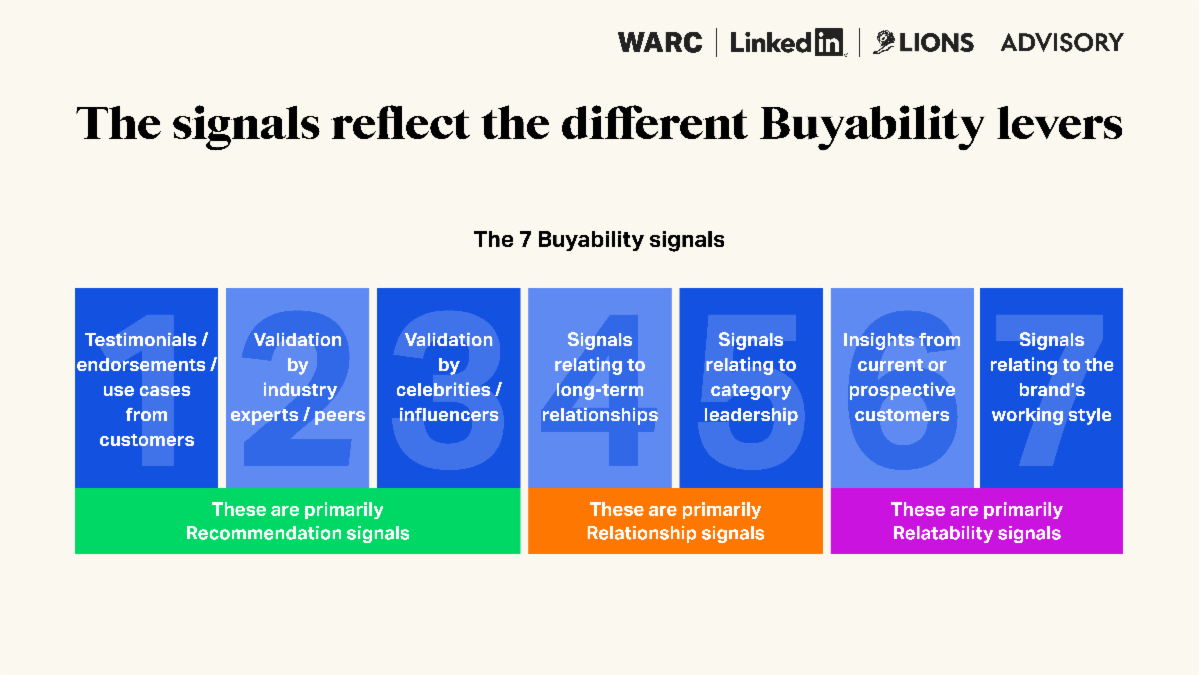
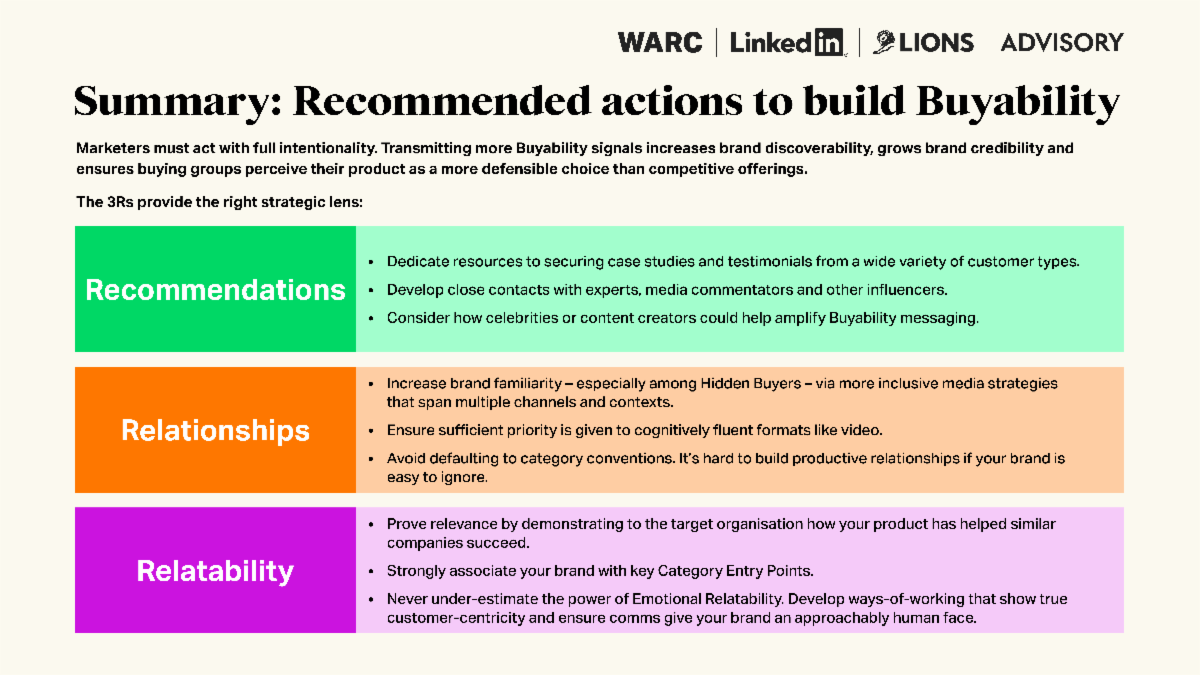
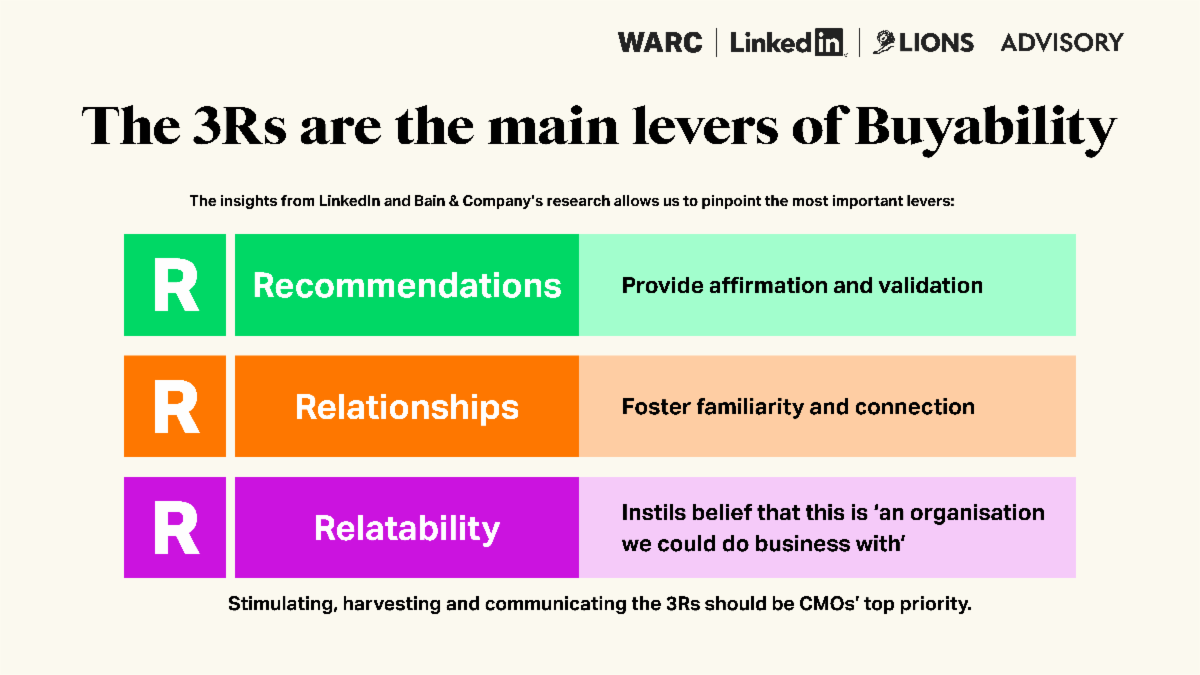
LinkedIn groups its findings into three areas, which it calls the 3Rs: Recommendations, Relationships and Relatability.

“Buyability gives us a seven signal framework that marketers can use to strategically enhance campaign outcomes because it is built on insights into what helps buying groups feel confident to buy. The campaigns that win are the ones that make buying decisions easy to defend by focusing on areas that customers can relate to and experiences and voices they can trust.”
Mimi Turner, Head of Marketplace Innovation at LinkedIn
Most campaigns use only one or two signals
To test the model, WARC and LIONS Advisory reviewed 700 B2B campaigns from 2010 to 2025, including entries and winners at Cannes Lions, the Effies and the WARC Effectiveness Awards. Each was checked for seven signals linked to the 3Rs: customer testimonials, backing from industry experts or peers, backing from celebrities or influencers, long-term relationships, category leadership, customer insight and the brand’s working style.
The average campaign used 1.6 of the seven. Nearly a third (30%) used just one, and 22% used none. Even campaigns with budgets above US$1m averaged only 2.25. The biggest difference between campaigns with three or more signals and those with fewer was the use of customer testimonials: 64% against 16%.
Imaad Ahmed, Thought Leadership Director at LIONS Advisory and WARC, says:
“As we found, intentional use of Buyability signals is still an opportunity for B2B marketers. When well-stacked within a campaign, Buyability signals can make revenue, ROI and brand health uplifts far more likely.”
Campaigns with three or more signals were 63% more likely to report higher ROI, 2.1 times as likely to report extra revenue and 91% more likely to report gains in consideration, preference and purchase intent.

The commercial results are an early read
To its credit, the report is upfront about the limits of its data. The numbers behind the headline ratios are relatively small: 13% of campaigns with three or more signals reported an ROI uplift, compared with 8% of the rest. For incremental revenue, the figures were 23% and 11%. The authors point out that award entries are written to make a case, that the sample only covers campaigns already seen as successful, and that many entries reported little hard commercial data. They describe the commercial findings as preliminary.

There’s also a gap between how the research was announced and what the report says. The press release says B2B marketing now needs to prove that it directly generates sales. The report finds that campaigns with more signals did no better than others at turning existing demand into sales. Their advantage showed up in longer-term measures, such as brand fame and customer affinity. My read is that Buyability is mostly a brand-building tool, and brand-building takes time to show up in sales.
The buyer research is on firmer ground. B2B purchases are group decisions, and the people in the group want to be covered if things go wrong. Most B2B marketing, and the way it gets measured, hasn’t caught up with that yet.