




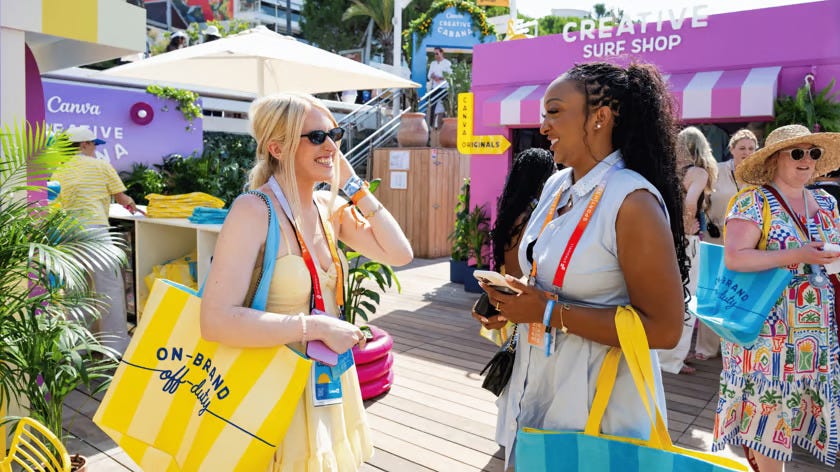
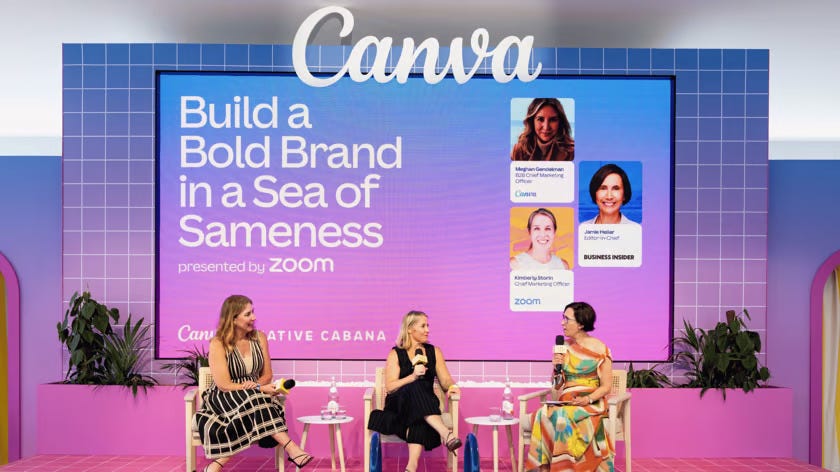
The Cannes Lions Festival runs on the idea that advertising is still the main event. Rory Dolan, who is Head of Data Science and Marketing at Canva, is not so sure. He last came in 2019, roughly the last year the festival was really about advertising, by his reckoning, and the platforms have moved in since then. “The industry has a short memory,” he told me at Canva’s palatial beach pavilion on the Croisette. “Meta, Google, TikTok all turned up as partners. And then the next AI players are probably going to consume the industry again.”
Which is a striking thing to say from inside Canva. The company arrived at this year’s festival as a partner to exactly those companies. Its advertising product, Canva Grow, pushes creative straight into Meta and TikTok and reads the results back. Dolan knows the pattern he is describing. He is, after all, helping to build part of it.
What drew him, he says, was partly the mission. Canva sells itself as a company “fundamentally trying to do good”, pointing to the free products it gives schools and non-profits, while presenting itself as an antidote to visual sameness. Dolan describes an industry “reducing down to different versions of grey, white, black and brown”, a condition he calls chromophobia; Canva’s maximalist brand is his answer to it.

Rory Dolan, Head of Data Science and Marketing, Canva
The point of the rules is to stop reinventing them
Dolan started in options trading in London, moved into media agencies almost by accident, spent close to 15 years across planning, buying and strategy, built a consultancy within WPP’s GroupM (Now WPP Media), then crossed to the platform side and set up TikTok’s marketing science function across Asia Pacific. The common thread was measurement. His turning point was discovering the Ehrenberg-Bass tradition, the body of work that treats marketing as a discipline with enduring rules. “There are core rules. It’s not always changing,” he said. For a discipline he had heard dismissed as a soft science, that was a revelation.
At Canva’s scale, that belief leads to standardisation. Dolan runs a system across many markets, and his job is to ensure that what reliably works is not debated from scratch every time. “Let’s stop trying to reinvent the wheel on the things we know work and focus our time and resources on the fun part,” he said, meaning the ads and the brand.
Canva is opening its first internal marketing academy this year, bringing in experts to teach both the principles and the company’s way of working. Dolan also runs the behavioural science and capability teams, and he hires for skills the company does not need yet. He reaches for J.G. Ballard, of all people, for the idea that the future is already visible in the present if you are willing to look for it. Better to build the capability before the moment arrives than to go scrambling after it.

A global brand should be mistaken for a local one
Canva has moved away from single global campaigns towards work made market-by-market. In Dolan’s experience, global creative travels badly. “We’re trying to build things which are culturally and emotionally connecting to people, and it’s hard to do that building ads from Sydney, or from LA,” he said. The ambition is for the brand to look and behave like a local one everywhere it operates. In Brazil and the Philippines, he found consumers surprised that Canva was not a Brazilian or Filipino company, a measure of success that doubles as a boast.
Going local raises creative and resourcing costs, and Dolan concedes as much. He argues that the extra cost is justified by effectiveness, pointing to the messenger effect in behavioural economics: people trust messages more when they come from those who resemble them, and that resemblance goes beyond gender or ethnicity to social and demographic factors. The mid-market brands winning through local relevance aren’t, in his view, doing it to save money.

Humour keeps earning its place. The research case is that a strong emotional reaction builds memory; it also happens to suit a brand that wants to feel positive. Canva’s UK campaign this year installed Gemma Collins, the reality-TV personality, as a mock creative director, filmed in its London office, with an AI tone-of-voice toggle built into the product itself. Canva’s own European marketing lead has since described British audiences as more cynical and more modest than American ones, which makes much the same case for localisation. Dolan has a simpler test. “Would your campaigns come up at a dinner party? And would people laugh when they talk about it?” If not, the work isn’t good enough.
Brand sets the ceiling on growth
The harder sell inside any company is the finance team. Strip out the jargon, he argues, and brand is demand generation while performance is demand capture. “If we want to increase our rate of growth, we’ve got to increase the ceiling,” he said. Short-term measurement still matters to him; he cites unified lift studies that show a measurable effect of brand exposure on performance. Timing is harder. He invokes Mark Pritchard of Procter & Gamble, while acknowledging the wording may not be exact: today’s sales were built a year ago, so the job is to think about a year from now.
His preferred image for long-term brand building is an engine. “If you turn the engine off, the plane doesn’t fall out of the sky immediately; it glides,” he said. The catch is that a brand can coast down slowly, which is exactly why the decline is easy to ignore. Climbing back then costs far more energy than the glide ever saved, and that is the part he wants finance directors to understand.
The loop Canva is closing could close on itself
Millions of designs are made inside Canva every day, and the company is turning that into an advertising business. Canva Grow, relaunched at this year’s Cannes Lions, lets a marketer build creative, push it live and have the conversion data flow back automatically through platform integrations. Dolan is clear that the point is response data rather than pre-testing. “The real measure comes from when you put it in front of a customer and see what actually happens,” he said. Canva has also been buying its way further into this territory. The direction of travel is towards owning more of the path from creation to measurement.
Cheap, instant variation is one of the promises of AI creative, and it is also what makes Dolan wary. “Just because you can doesn’t mean you should build all those variations,” he said. He traces creative fatigue less to the ads themselves than to platform attention metrics that reward endless novelty. He has imposed rules to protect the quality of the signal, including a block on forced-view advertising, because the clearest signal is whether someone chooses to watch at all.
Dolan’s response is that Canva keeps the optimisation at arm’s length. The work of improving creative with the platforms, he says, sits “above the business”, built from the platforms’ own meta-analyses and shared playbooks “rather than us going through our customer data”. The aim is to start with best practice and let clients build their own expertise from there. He also points out that platform data can mislead in both directions: a weaker ad can outperform a stronger one “just because of how the algorithms work”.
A creation-to-performance loop risks rewarding whatever the platforms already reward. At enterprise scale, it will also need a measure of performance that stands apart from any single platform. Automate variation against platform feedback and you risk producing, at speed, the same kind of sameness Dolan blames on short-termism. This is the chromophobia Canva’s brand is supposed to cure, and the risk is that the loop he is helping to build could create more of it.


The people who translate are worth more than the people who know
Dolan gives his teams a particular instruction. He looks for depth in one or two areas on top of broad range and tells his people their job is to be “the second-best opinion on anything in the room.” Put those skills together, he reckons, and that makes someone one of the most valuable people in the room. The scarcer skill is translation: turning marketing metrics into language that finance, product and leadership teams understand. He hires for potential as much as completeness; if a role needs five capabilities, he will take someone with three and build the rest.
On AI he is deliberately understated. He expects next year’s conversation to be about products built for mass consumers rather than the industry talking to itself. “Anyone who knows what a context window is probably not part of the wider consumer audience,” he said. AI, as he frames it, should feel like magic and behave like a tool. Treating it as a category in itself misses the point, he argues, in the same way you would not call a hammer construction. Canva, he insists, doesn’t believe in replacing people. The point is to remove the barriers between what is in someone’s head and what they can make.
It is a comfortable position for a design company that frames itself as a force for good, and a harder one to hold while the same company closes the loop between creating an ad and measuring it, a process that has not historically required an agency to sit inside it. Dolan’s own reading of the festival was that every platform arrives as a partner and leaves having eaten something. Canva is a partner now. Whether the rules it is so carefully writing down protect creativity, or simply help industrialise its disappearance, is the question he has set himself. This year does not settle it.
