



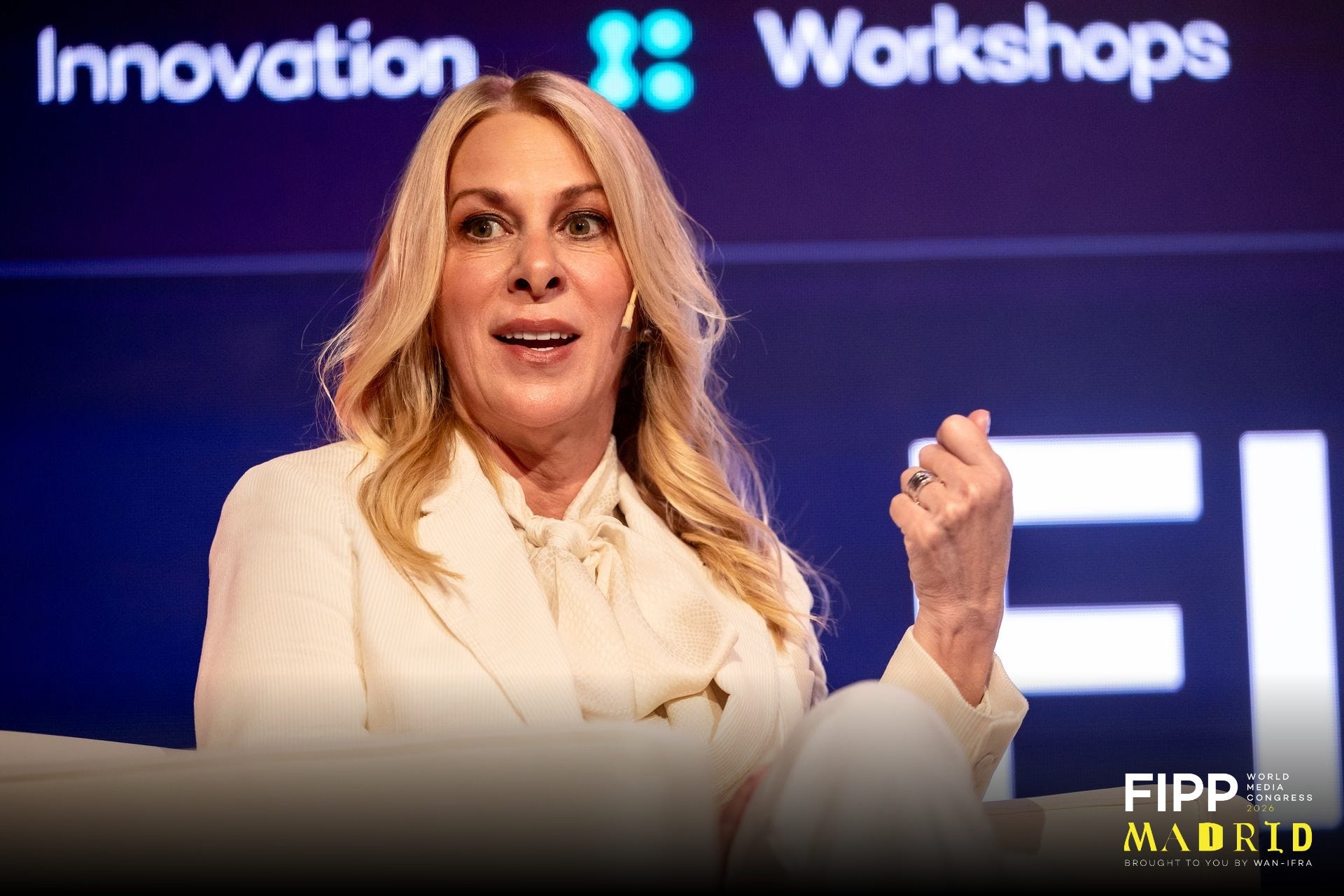
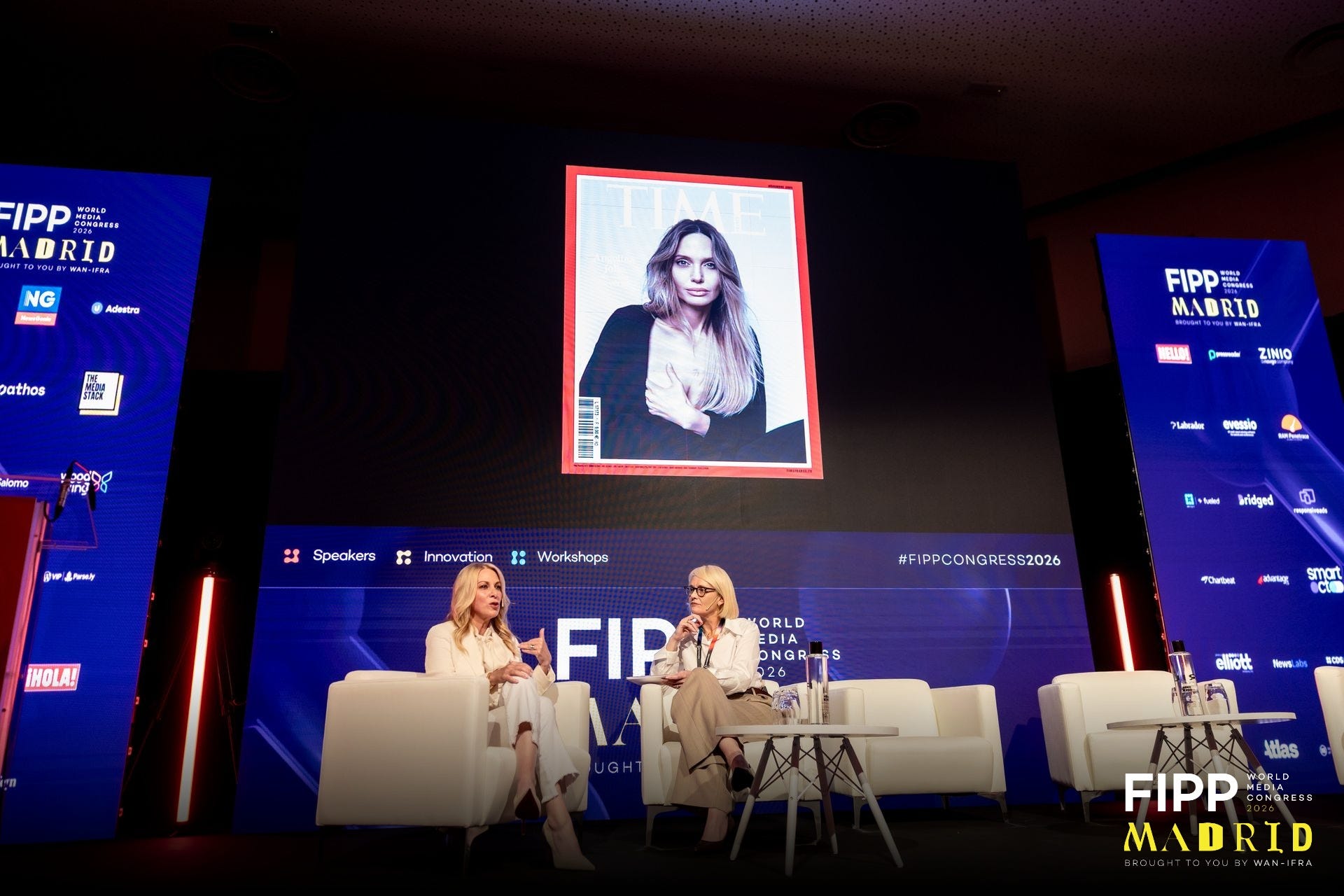
Thirty minutes before Jessica Sibley walked on stage in Madrid, Time published its first interview with John Ternus, Apple’s new Chief Executive. He had given it to nobody else. The cover, timed to the launch of the $2,000 iPhone Duo, was the last thing she checked on her phone before the closing session of the FIPP World Media Congress, where she spoke with Minette Ferreira of Media24.
That access, she argued, is the asset everything else at Time is built on. The question she has spent four years answering is what to build.
Time 3.0 began on a blank screen, three months before she had the job
During the recruitment process in 2022, Sibley was asked what she would do with Time. She wrote “Time 3.0” on an empty document, and the phrase became a rallying cry before it was a plan. By the day she joined she had a written plan, though, as she put it, “while I thought I had all the answers, I knew I didn’t.”
Her first act was to leave the building. Rather than sit with consultants and a whiteboard, she announced she would meet 100 stakeholders in 100 days, pegged to the magazine’s centenary, and hit the number far faster. Politicians, media buyers, chief executives and celebrities all had a Time story, and told it to her as though it were personal.
The commercial diagnosis was blunter. Time had made the move to digital later and less successfully than its rivals. She chose not to chase them. “Do we look back and try to catch up? I kind of thought of that as chasing trends. Or should we just prioritise our priorities and figure out how to build the best version of ourselves?”
The Google Zero dashboard was built before Google Zero was a slogan
A chief product officer was hired within days of her arrival, and one of the first things the team built was a dashboard showing what Time would look like with no Google traffic at all: if search went away, which businesses still worked? The answer shaped the diversification that followed. “We have a smaller website, but we’ve got the largest social audience in our history,” she said. The site matters less than the brand’s reach, and she argued the same logic now must apply to AI.
The cover gets you the stage, and the stage gets you the room
Time’s events and franchises are now its commercial engine. Nine covers in ten carry a person, and Sibley noticed early that everyone wanted to be on one, even people who had stopped giving interviews. “When you’re on the cover of Time, you then are on the stage,” she said, and the stage is where Time gathers the community it then sells to sponsors.
Her example was Taylor Swift, Person of the Year in 2023. “She doesn’t have to give an interview. She could talk to her fans directly. She knew being Person of the Year on the cover of Time was history-making.” The Time100 franchise has since expanded into AI, health and creators, and the newsroom’s question for every list is the same: is it your year?
Why Time? Her answer was trust, which she called the brand’s number one priority, backed by a century of reputation. Many publishers say as much; few have the cover list to show for it.

The AI strategy started with a text message and a pause
Sibley’s account of Time’s AI journey began on the day ChatGPT launched, when Marc Benioff, Time’s owner, texted to say Sam Altman would call her directly. He did. Benioff’s instruction was short: “I trust Sam Altman. You guys can figure this out.” Then Time stopped and worked out what it was doing.
She described five phases. First, infrastructure: protecting IP, understanding what AI systems were doing with 100 years of journalism, training the newsroom on the tools, and getting a seat at the table with the companies building them. Second, a decision to negotiate with the AI companies over the value of Time’s content. Third, licensing and partnerships. Fourth, products, built with Scale AI, including the Time AI agent that summarises articles, reads them aloud and searches the archive in 13 languages. Fifth, and current, advertising.
Agents want the opposite of what readers want
The infrastructure work revealed a pattern in Time’s own traffic: agents were arriving in volume, and Time concluded the open web was heading toward a point where they would outnumber humans. By Time’s own account, it has already arrived on some days: Mark Howard, its Chief Operating Officer, told Digiday in July that the site sees more bot traffic than human traffic “most days”.
She decided to treat them as an audience. They are agents working for people, answering questions, informing decisions, and increasingly making purchases, and they go looking for trusted sources. What they want from a page is nothing like what a reader wants. “Humans are coming to Time.com, and you’re seeing our beautiful visuals and our covers. Agents want the opposite. They also want speed, but they want a machine-readable version that doesn’t have any of the stuff that humans want. They want structured data.”
So Time, with the ad-tech firm Mobian, began serving agents a text-only markdown version of its pages and, in July, sold the first ads written for them. Ally Bank, sponsor of the Time100 Creators list, ran a conventional campaign for readers and, alongside it, an agent ad: a plain-text set of brand-verified facts about its products and positioning, labelled as sponsored and structured for machines to ingest.
The pitch to brands rests on three measures: visibility, favourability and accuracy. A study of 750 blue-chip brands by Mobian, which sells the product, found what Sibley called a “pretty big” discrepancy between what AI systems say about them and their verified facts, which she put down to outdated or untrusted sources. Time’s offer is to close the gap, with its own trusted pages as the carrier.
Ferreira closed on the convergence of the Congress’s two themes, trust and AI. Whether a page built for machines can carry the trust earned by a page built for people is the question Time is now being paid to answer. Sibley’s advice to the room was the line she had used for Time’s own journey. “Don’t let AI happen to you,” she said. “Let AI happen for you.”