



The first day of Piano Academy in Amsterdam brought product news, chiefly that Stripe Checkout is coming to the Piano platform. Four practical sessions, from a German regional publisher, the BBC’s commercial arm, a Dutch data agency and Piano with Stripe, made the same case: the revenue publishers are missing sits in audiences, subscriptions and data they already hold.
The most loyal readers are also the best advertising inventory
pd digital runs the digital operation for Mediengruppe Pressedruck, publisher of the Augsburger Allgemeine and a cluster of regional titles in southern Germany. Jürgen Risinger, its Head of Subscription Technology and UX, began with a diagnosis most of the room shared: search traffic down sharply, CPMs following it, and no appetite for compensating with more ads. “Our traditional approach of monetising our digital products does not work anymore, or at least it’s not as effective as it has been in the past,” he said.
The response, built during a relaunch of the group’s news sites on a single platform, is what pd digital calls revenue-driven design. Piano Audience sorts each visitor into one of five tiers:
Unknown.
Low loyalty (one visit day in the past 30).
Mid loyalty (two to four visit days).
High loyalty (five or more).
Subscribers.
A server-side call passes the segment to the CMS, which serves the matching template. Unknown and low-loyalty visitors, many arriving from Google Discover, get heavier ad loads and nationally sold campaigns. As loyalty rises, ad load falls, the advertising becomes more relevant and subscription offers grow more prominent. “Why bother a first-time user coming from Google Discover with a subscription offer?” Risinger asked.
Piano’s Ad Revenue Insights, which attributes advertising income to content and users, supplied the measurement. The ad operations team reported:
● 20% better ad visibility.
● 7% higher average CPMs.
● 11% more ads per page view.
● 32% more revenue per page view.


Subscribers spend more time on the sites each day and generate around 11% more page impressions.
High-loyalty users are about 4% of visitors and produce 28.5% of digital advertising revenue. Subscribers are 1% of monthly visitors, 10% of advertising revenue and, once subscription income is added, about half of digital revenue. Some articles with 50,000 page views, Risinger said, earn far more than others with 100,000.
Relaunches usually pit newsroom, ad sales and reader revenue against each other over placements. At pd digital, tests now settle those arguments. “If you have good data, you can prove that the design works,” Risinger said. The concept is shortlisted for Piano’s new awards, decided on day two.

Breaking news was costing the BBC subscribers
Joe Iles and George Agate of BBC Studios reported on progress since the BBC.com subscription launched for US audiences in June last year. It is now live in the US and Canada across web, iOS and Android.The BBC moved cautiously, starting with about 10% of audiences eligible and running a likelihood-to-subscribe model before switching to Piano’s dynamic paywall, always the goal for a business that relies on both advertising and subscriptions. In a 50/50 test, the dynamic version put the paywall in front of 160,000 more visitors with little cost to advertising, finding converts among thinly engaged users through contextual signals.
During major news spikes, page views at times doubled while subscriptions fell by 25%. Readers landed on the live page and went no further. The BBC’s fix was editorial. A redesigned homepage now wraps the live page in paywalled analysis of the same story. Since the change, page views and conversions have risen together.
A meter of about four pages works for most users. Some 42% of active subscribers converted in the iOS or Android apps. In Canada iOS is the largest subscription surface, ahead of the web. Bringing propensity models to the apps is next.
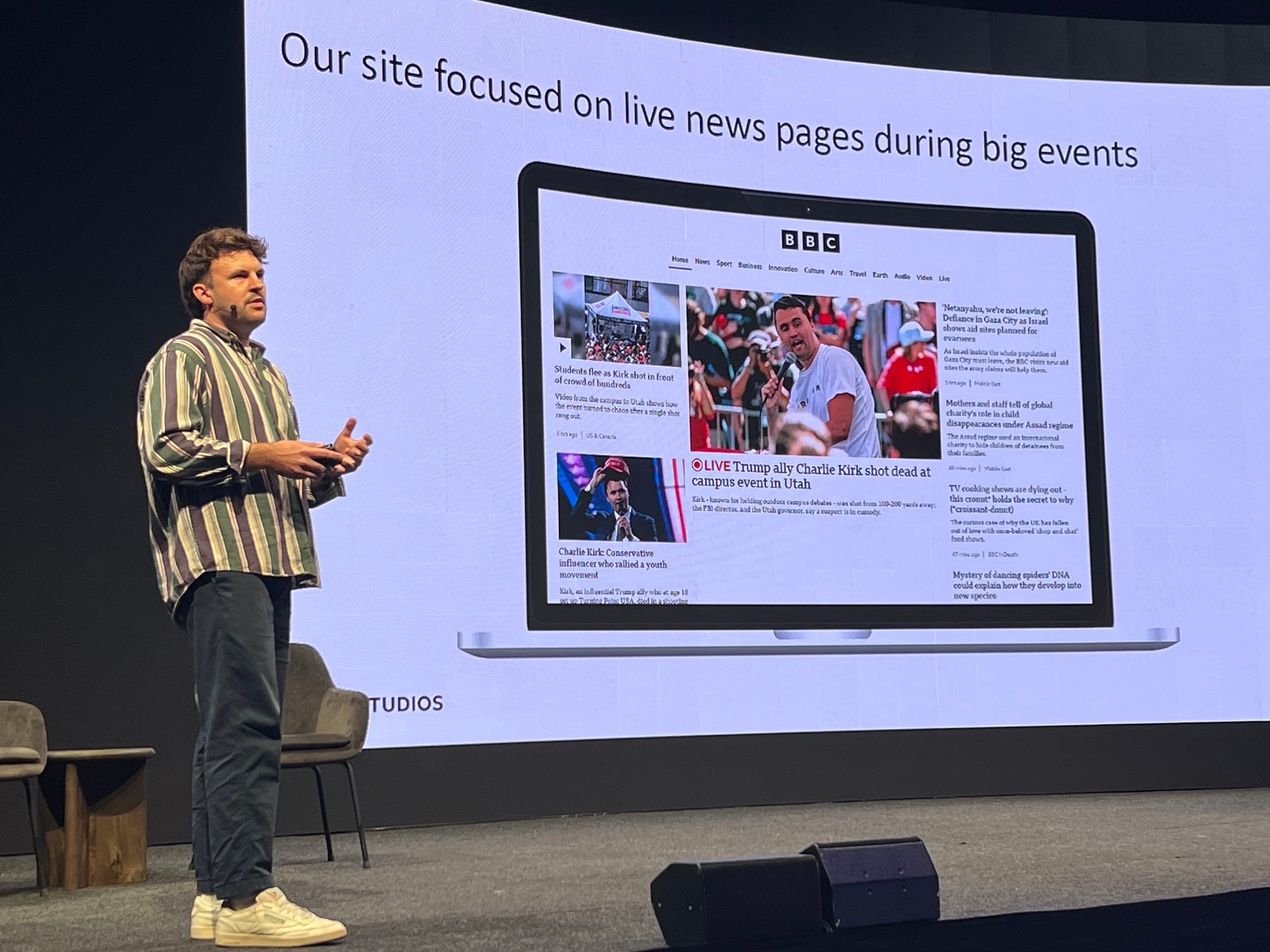
The BBC also places no Meta or Google pixels on its sites. Events collected through Piano go to Snowflake, and the BBC decides which go back to the ad platforms through conversion APIs, stripping metadata such as URLs. “We choose what events we send to the advertising platforms. We choose when we send them,” said Agate. A high revenue-score event can now feed Meta’s and Google’s optimisation without a pixel, and the funnel is running at a positive ROI.
After the move to Stripe Billing, Smart Retries lifted payment recovery so sharply that Iles called the chart “completely bananas”. Before, the BBC recovered 40 to 60% of failed payments within two weeks; now, Iles said, it barely loses subscribers that way.

A third of churn is a billing failure nobody owns
Failed payments were the subject for Tim Rowell, Piano’s SVP Global Publishing, and Jana Aleksic, Stripe’s Customer Success Manager for Piano. Across Piano’s clients, 33% of churn is involuntary: expired cards, replaced cards, declines on security grounds. Even after grace periods, 2.4% of monthly subscribers are lost to payment failure each cycle, roughly a quarter of the cohort a year.
Rowell blamed how publishers are organised. “Acquisition is the primary focus. That’s what receives the budget. That’s what’s reported on in the weekly meeting,” he said. Payments often sit in finance as a vendor relationship, with nobody owning the numbers day to day.
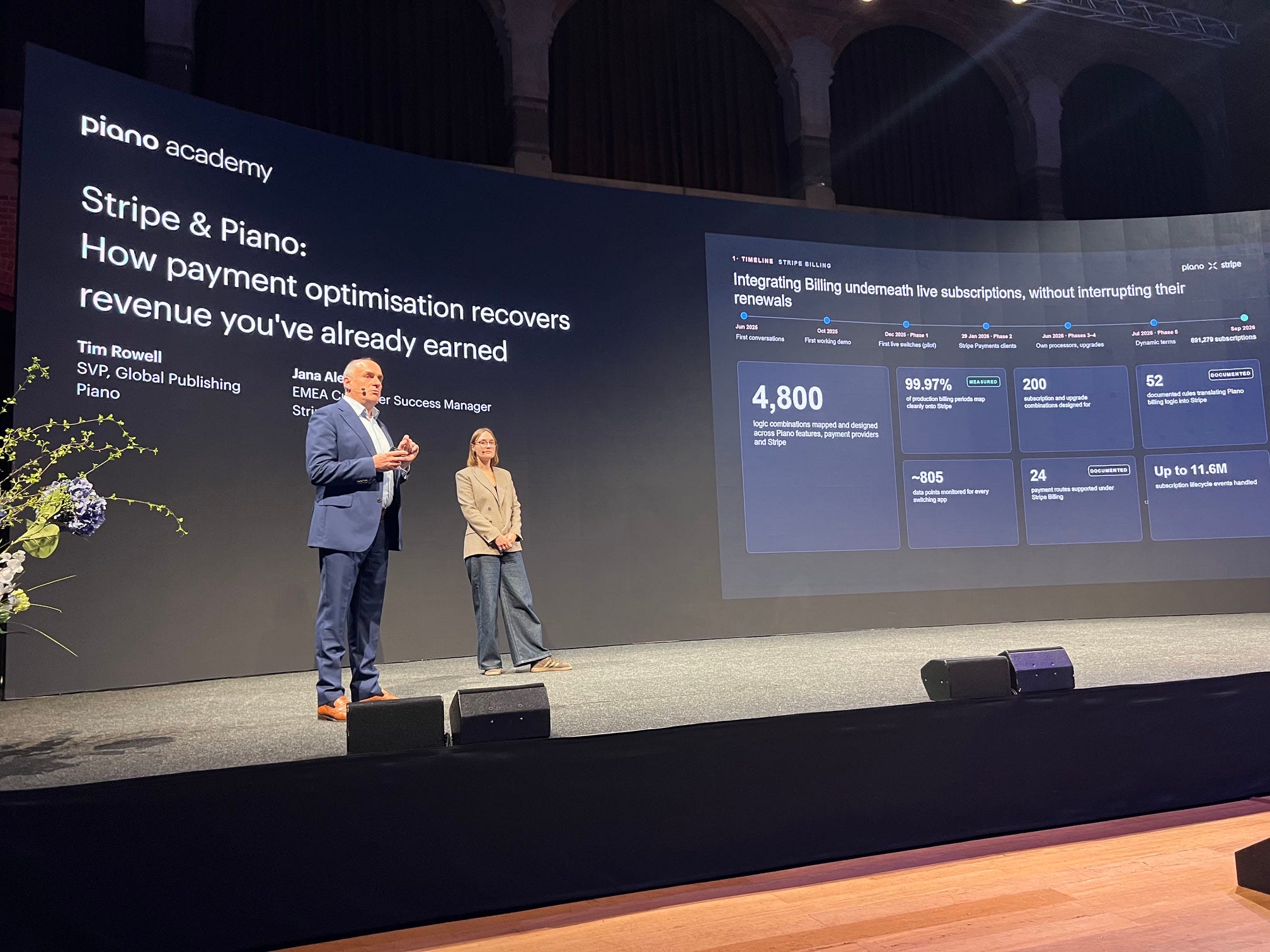
Aleksic argued that each decline reason needs its own response, with dunning emails reserved for cases where the customer must act. Billing, messaging and access must also move together, or a recovered subscriber still meets a paywall. She left four questions to put to payment providers:
● What are your authorisation rates, from first attempt to final, ideally by market?
● Why do renewals fail, and which causes can you influence?
● What share of initially failed payments do you recover?
● During recovery, do billing, messaging and access stay in step?
“I honestly don’t think many of our clients can answer these questions off the cuff,” Rowell conceded.
Piano’s own migration to Stripe Billing now covers about a million subscriptions, with one failure per 10,000 switches. Early data from the first clients moved shows the share of failed renewals recovered rising from 15.4% to 55.1%.
When everyone buys the same AI, the input data is the only edge
Janus de Visser, Founder of Cloud Nine Digital, took the argument into marketing automation. Google says 80% of its advertisers use one of its AI tools. Citing the IAB’s State of Data 2026 report, de Visser said half of respondents are already scaling AI in marketing measurement, yet 75% say the tools underperform on trust, rigour and efficiency. Tools such as Meta’s Advantage+ and Google’s AI Max take spending decisions inside systems no outsider can inspect. If competitors run the same black boxes, de Visser argued, the data going into them is the only lever left.
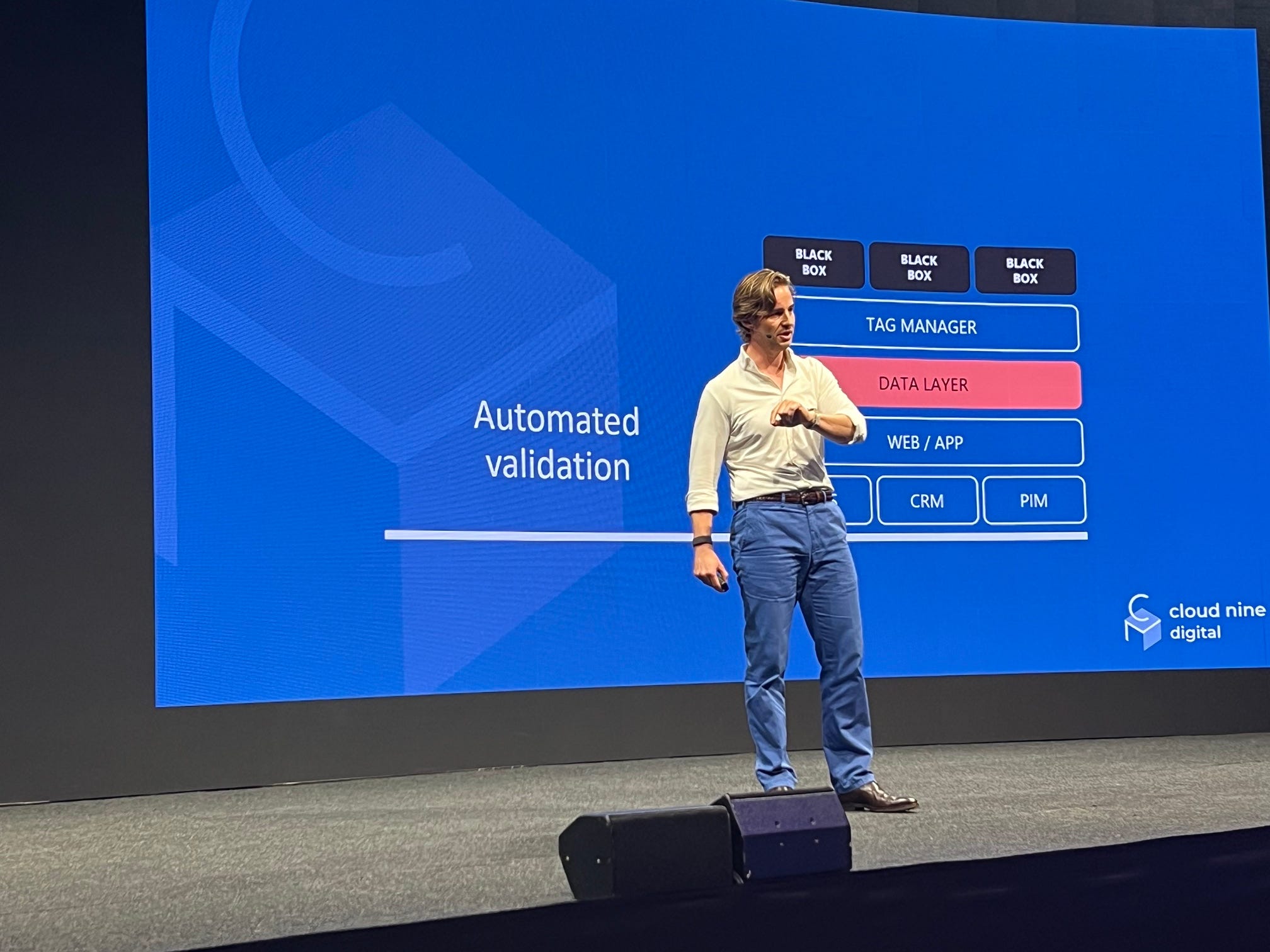
One client lost €5m in revenue over five days when one layer of its data set-up failed and the algorithm kept spending. A theme park’s campaign nosedived when add-to-cart tracking failed on a single mobile device and browser combination, removing 30% of those events.
“If you automate the decision, I believe you have to automate the validation of the data you send into the machine that makes the decision,” de Visser said. He dismissed the one-off audit as “the illusion of the truth”, since a set-up can look different the day after.
None of the speakers said who inside a publisher should own segment templates, renewal recovery or tag health..
