



Please note all of these sessions were conducted in Spanish and Catalonian recorded using AI and translated to English using AI all efforts have been made to ensure accuracy.
On Monday, Media Party, the journalism and technology conference founded in Buenos Aires, opened its first European edition at CaixaForum Barcelona, with close to 600 registrations and a hackathon scheduled for day three. Marc Melillas, the Generalitat’s Director General of Media, used his welcome to note where the money goes: companies commit millions to AI while almost nothing goes into the ethics of how democracies use it. Mariano Blejman, the founder, listed what the format has produced, including GPTZero, presented by Edward Tian at the 2023 Chicago edition; it went on to raise around $15m. Media Party, Blejman said, is evaluating opening a space in Barcelona. The three keynotes that followed all turned on trust, and each speaker meant something different by it.

Verifying the output is the real cost
Teresa Mondría Terol of NPR worked inside the New York Times newsroom on the Epstein files and used that investigation as her anatomy lesson. Her test before any AI project has two parts: which stories become possible when time is no longer the limit, and where checking the output will cost more than the tool saves. “In the end it generates more information than you had at the start, and that doesn’t help us.”
Reconstructing the relationship between Steve Bannon and Jeffrey Epstein in the months before Epstein’s death meant finding their exchanges inside millions of documents, from flight records to iMessages. The two did not always call each other Steve and Jeffrey; initials and nicknames recur. An AI agent working in natural language found the first traces. Machine learning pulled every page on which either addressed the other, and generative AI extracted dates from messages in inconsistent formats. Every message was then verified one by one.
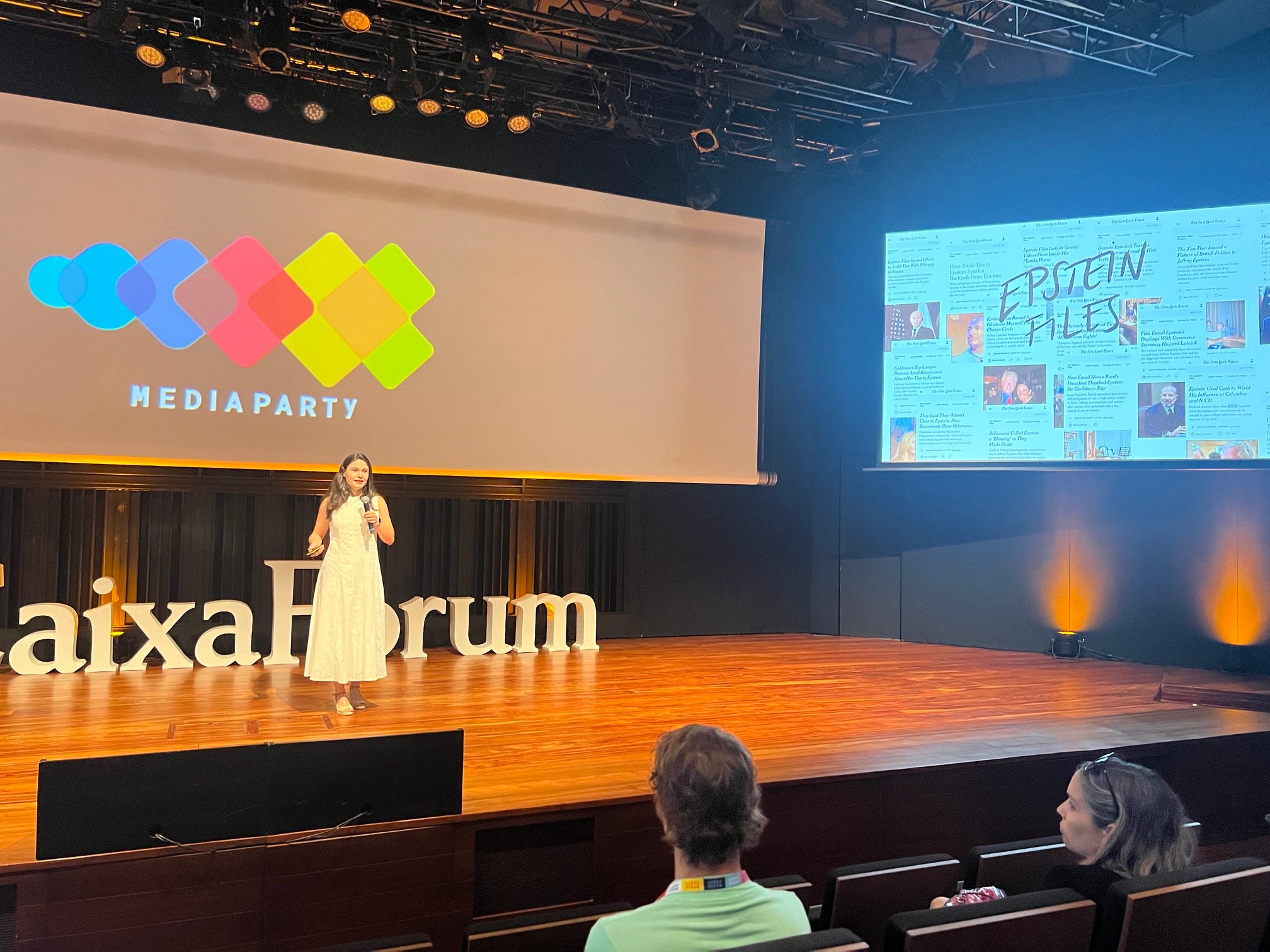
The same team described images and video frames to build a semantic search, so reporters could look for Epstein’s New Mexico ranch in words, and built agents that let journalists new to the story query the documents with citations back to the originals. For the second anniversary of 7 October, AI extracted everyone from or living in Gaza whom the paper had spoken to over two years; verification meant reading each source document in full and re-running the instructions to catch omissions.
The methods are not confined to investigations. The New York Times runs hundreds of hours of manosphere podcast audio through models to produce five-minute daily digests, so the reporters on that shift can follow the discourse without listening to all of it; the Wall Street Journal, she said, does the same. A local media group she cited transcribes and summarises recordings of public meetings no reporter attended. An open-source plugin now let’s newsrooms run document-by-document classification inside Google Sheets; she uses it herself, and at NPR is building internal search engines tailored to the production processes of individual podcasts. Her advice for newsrooms starting out: use it early in an investigation, when the job is locating the metal in the haystack, and in internal processes where mistakes surface sooner.
3Cat is chasing trust to wherever it settles next
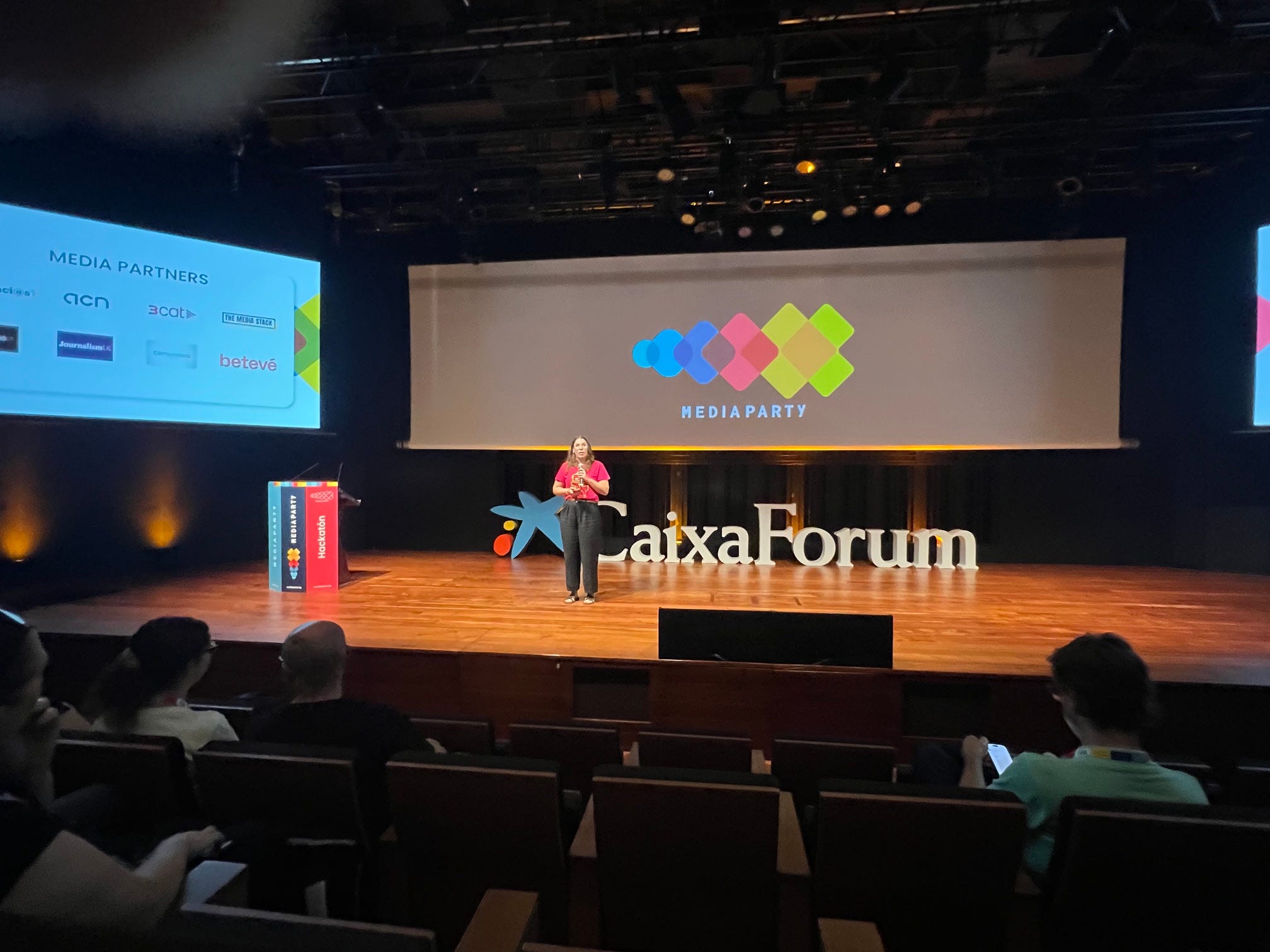
Judith de Argila, Director of Digital Audience Development at 3Cat, Catalonia’s public broadcaster, described a news transformation begun from a position of strength. 3Cat leads television news in Catalonia. The result is 3Catinfo, a news brand built on integrating television, radio and digital production.
She named three problems.
Visibility: algorithms set the agenda, and the live questions include whether 3Cat’s content surfaces in ChatGPT and whether its app sits in Samsung’s marketplace.
Disconnection: journalism’s taste for nuance and data reads to many people as elitist. Trust: the hierarchy in which governments and media set the agenda has gone.
The responses: content made natively for social platforms; WhatsApp, Telegram and Instagram channels outside algorithmic feeds; distribution deals sought with Spotify and Samsung; an app rebuilt around scroll and vertical video; a verification unit whose head appears on bulletins explaining how stories were checked, with capsules pushed through WhatsApp to counter falsehoods on the same channel. The media, she added, are lobbying at European level for AI companies to prioritise their sources in answers. The 3Catinfo Instagram profile now reaches around three million people with news content alone.

The broader claim was that trust is being deposited elsewhere, with independent journalists, creators and individuals, and the next question is what happens when people ask ChatGPT, Gemini or Claude instead of a journalist.


PRISA bet on patience over speed
Olalla Novoa Ojea, PRISA Media’s Director of Artificial Intelligence, described a year spent on governance. When the work began, the group already had more than 30 AI projects catalogued, some in production, and a choice. “We could carry on doing pilot after pilot,” she said, “or pause momentarily and build the foundations that would let us run faster afterwards.” A group-level responsible-use policy, approved in December 2024 to follow the EU AI Act, went to every inbox; she doubted many read to the end.
An AI Oversight Committee meets every two weeks, with legal, compliance, privacy, technology, AI, sustainability and HR at the table, and reviews use cases from newsrooms and non-editorial teams alike. An executive committee led by the CEO meets every two months to set strategy and take escalations. Every proposal answers three questions: what problem, how, and why, the last covering alignment with editorial principles and audiences. Tools and use cases are approved as a pair; change either and the review restarts. Nothing reaches the committee without a manager’s budget. “No money, no project.” She had expected the fortnightly cycle to become a bottleneck. “Quite the opposite: it runs like clockwork.”
The instruments are deliberately plain. A use-case sheet, adapted from a technology template to a journalistic setting, makes teams write down what, how and why before they ask. An intranet AI hub, still in beta, holds the policies, training on demand, a prompt library and a community of practice where staff post the problems they hit. Monthly office hours and two ambassador networks carry questions back to the AI team.
A year in more than 1,000 staff trained, though that is 60% of those invited; 21 use cases approved; eight projects live or in development. Shadow IT persists, and PRISA chose training over blocking. Agent governance is the 2027 problem, with a first agent sheet drafted, alongside vibe coding by staff who have never programmed, which has to be squared with the group’s secure software protocol. Her close named the asset all this protects: 50 years of El País, more than a century of Cadena SER, more than 75 years of Caracol. Competitive advantage, she said, will not go to whoever deploys the newest model. “Trust is built with governance.”
PRISA’s oversight committee meets every fortnight. The audience de Argila described is moving its trust to creators and chatbots on a shorter cycle than that. The gap between those two clocks is where the rest of the programme sits.