



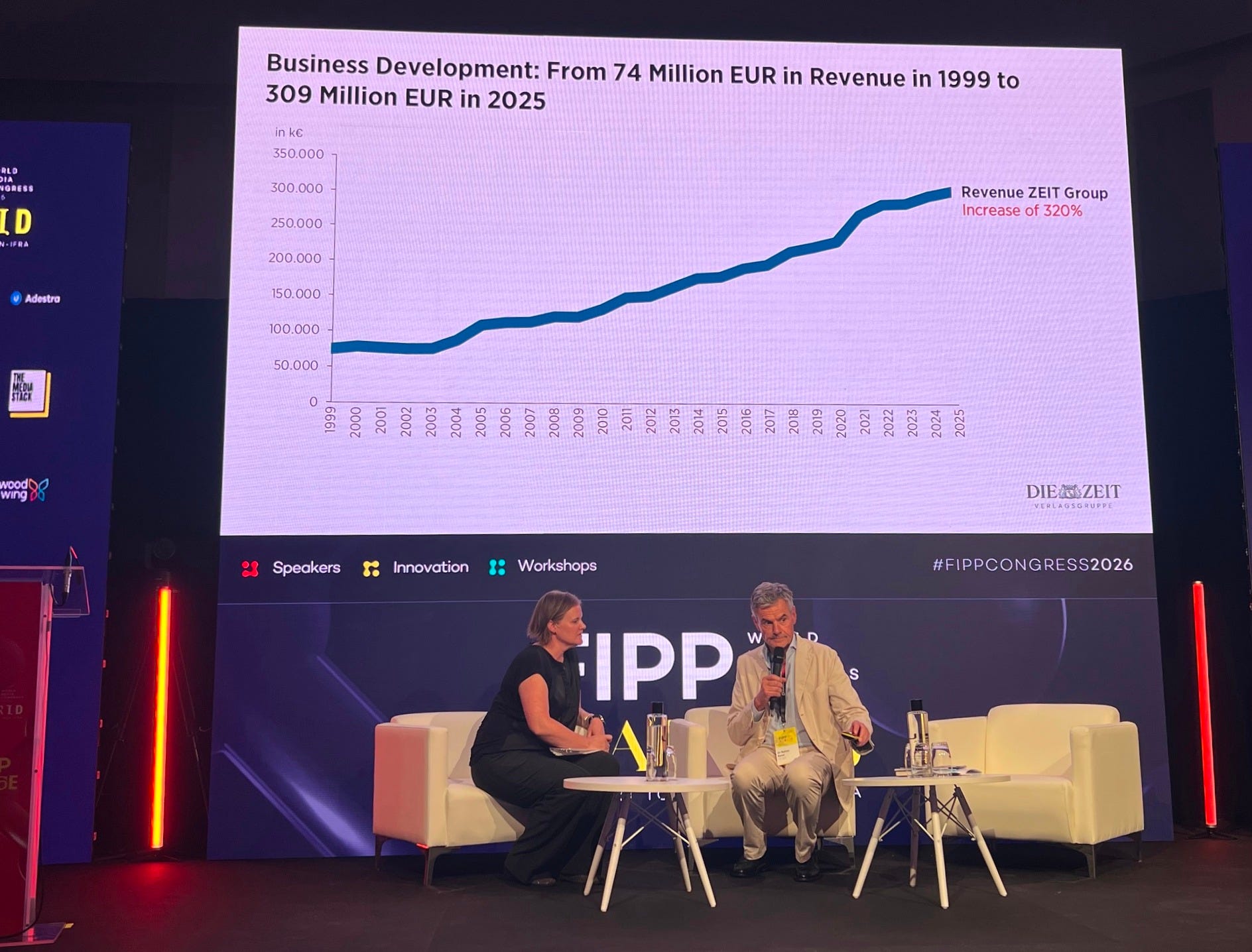
Rainer Esser arrived at DIE ZEIT in 1999 to a company turning over €74m, with 300 staff, 90 of them journalists, and a front page so dense with text that the newsroom called it the tomb. He handed the Chief Executive’s job to Nils von der Kall in February 2026, after 27 years, with revenue at €309m, an editorial staff of around 500 and just over half a million subscriptions, more than half of them digital.
When Käthe Lemon, President and co-owner of Canada’s RedPoint Media Group, asked him on stage at the FIPP World Media Congress in Madrid how he had done it, his first answer was magic. “There is some kind of magic around,” he said. What followed was closer to a method.

Digital subscriptions paid for the newsroom, and the newsroom paid for the rest
When Esser started, ZEIT sold 400,000 copies a week, 220,000 of them on subscription. Subscriptions now stand at 500,000, and the growth has been digital. “The cost of a digital subscription is very low,” Esser said. “If I have one more, it goes directly to the bottom line.”
The margin went on people. The editorial staff grew more than fivefold, and the coverage grew with it, from politics, economics, science and culture in the paper to an online ambition he described as accompanying subscribers “from the cradle to the grave, and maybe beyond.”
The weekly that was a single product in 1999 is now a stable of magazines, a travel business, a recruitment business, events and conferences, an academy and a podcast operation he called the strongest in Germany, at close to 20 million downloads a month. The tomb got photographs and subheads.
Be like a dolphin
The subscription arithmetic is the easy part of Esser’s explanation. The rest is culture.
He comes, he said, from a tradition in which the editorial and commercial sides “work very closely together”, with separate responsibilities but pulling in the same direction. He contrasted it with serious newspapers where editors compete with one another and reached for his preferred metaphor. Dolphins play, travel in groups and help each other. “It’s not paradise inside, but we live pretty close to paradise.”
The playing is literal: someone’s birthday every day, a magazine turning ten or fifty, travel writers coming home, all of it celebrated, because Esser believes ideas come from people in the same room.
The same belief rules out working from home. “I hate remote work. When you look at Google, you can work remotely. When you’re in a creative company where you rely on new ideas, remote work is not a good idea.”
Lemon called it idealistic, hard to copy and no explanation for €74m becoming €309m. She asked for specifics.

€20,000 and a hug: how ZEIT Verbrechen happened
The example he gave was crime. A decade or so ago, an editor came to him with a passion for crime stories and a plan for a magazine. “I hate crime. I do not read crime stories,” Esser said. He said yes anyway, refused the budget the editor asked for and granted a small one, around €20,000.
The first issues sold. Then Jochen Wegner, Editor-in-Chief of ZEIT ONLINE, suggested to Sabine Rückert, who ran the crime title, that it should become a podcast. Her reply, in Esser’s telling: “What is a podcast?” ZEIT Verbrechen (Verbrechen means crime) is now Germany’s biggest true-crime podcast, and Rückert, in Esser’s words, is its podcast queen.
The lesson he draws is about method. Start fast and small, so that expectations are low and failure is cheap. Then refuse to punish it. “We have no blaming game inside. If somebody is unsuccessful, I hug him and try to help him become successful.” An innovation budget is wasted, he said, if people in the building believe mistakes are forbidden.
Lemon’s second challenge was direct: funding risk is easy at €309m; how do you do it when you are small, unprofitable and nobody believes you?
Esser’s answer went back to 1999. His first presentation to the editorial team promised big projects and growth, and “they looked at me: this guy is completely crazy.” From there, he said, it was step by step, and not losing courage. Asked whether he ever had doubts, he said: “To be honest, I have no doubts.”

Hire young mothers, go home at six
The other specific was hiring. His team in 1999 was all men his own age. He hired women to reach a 50-50 mix and, he said, young mothers, because the workday then ended at six. “There is no time to talk about anecdotes. Decision, decision, decision.”
It is a rationale that would make most HR directors wince, though the underlying claim, that a team which must leave on time decides faster, is one plenty of managers would quietly accept. Lemon summed up the method so far, and he accepted it: a culture of innovation, an embrace of failure, and hiring young mothers.
The owner’s money went to TikTok
The TikTok bet was the owner’s, though Esser had seen it coming first. On a trip to China in 2019 he watched short vertical video take off on Douyin, TikTok’s Chinese sister app, and came home and wrote to the owner urging ZEIT to follow. The first line of his memo, he said, was the word Douyin, three times. Nothing came of it.
In 2024, the owner came to him and asked whether he knew TikTok. Esser said he was responsible for the bottom line and TikTok did not make money. “Rainer, that’s my money. Go to TikTok.”
The motive was partly political: in Germany, Esser said, social media is driven by extremists, and the owner wanted ZEIT’s money used to push back against that. A team of trainee journalists now works full time on vertical video for TikTok.

The business logic is the audience's age. Print readers are ageing; ZEIT’s digital subscribers are in their 40s; the target is 20 to 25, and audio, whose listeners are younger and more often women, is the other way to reach them. “Our audience is from 20 to 80, and beyond, and before,” he said.
Asked for a final takeaway, Esser said to spend less time on analysis. “The analysis of why things do not work is easy. Make the analysis, but then quickly move to: what can we do?” Someone in the building will always say it was tried years ago and failed. “Just do. Move and grow. Be like a dolphin.”
The growth has slowed. The German trade title Horizont put 2025 group revenue at €309.7m, up 1.2% on the year, with the core business still growing and the newer ventures falling back. That is what von der Kall takes on, along with an open question: a culture this dependent on one man’s certainty now has to work without him in the Chief Executive’s chair.