



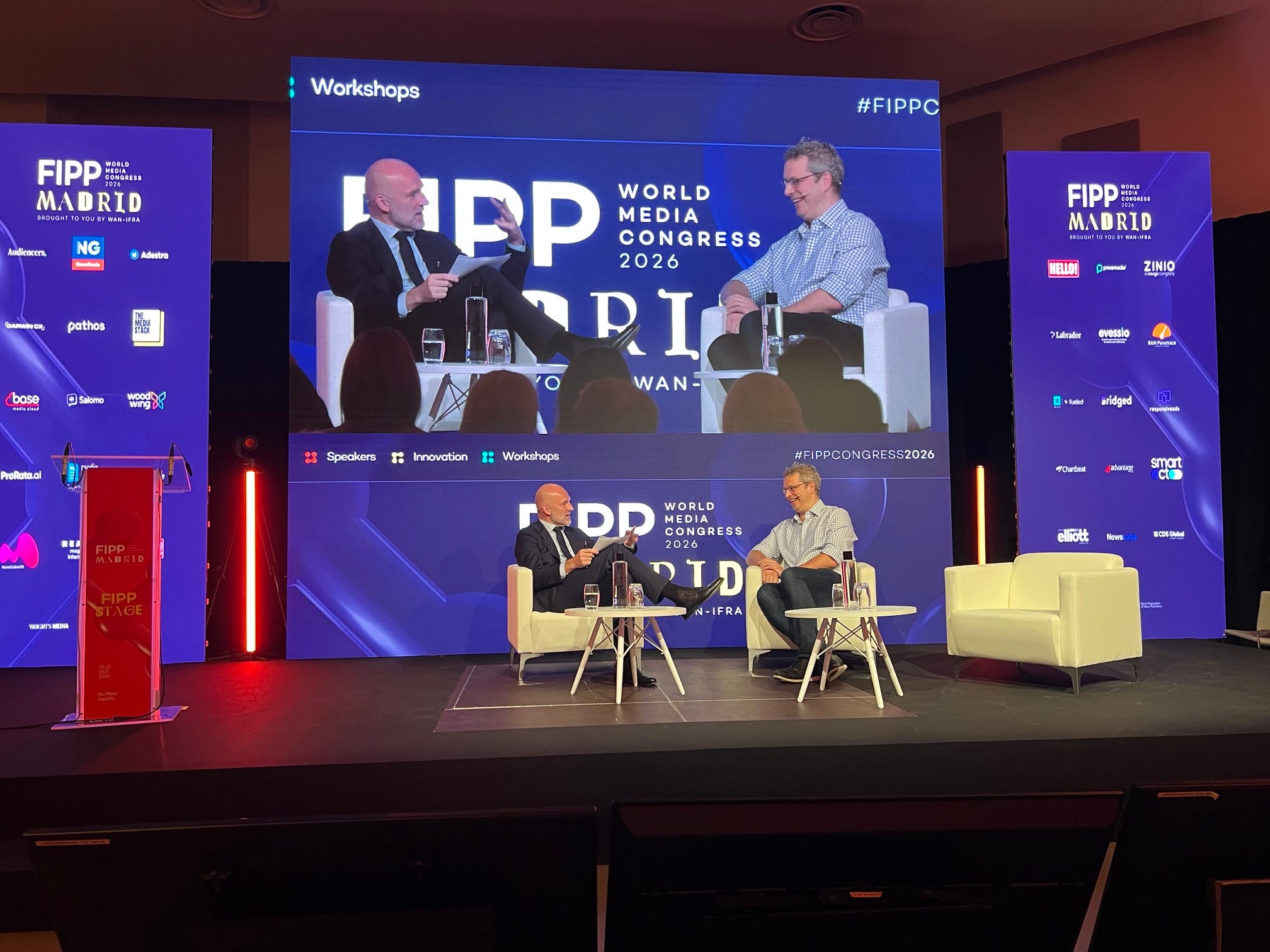
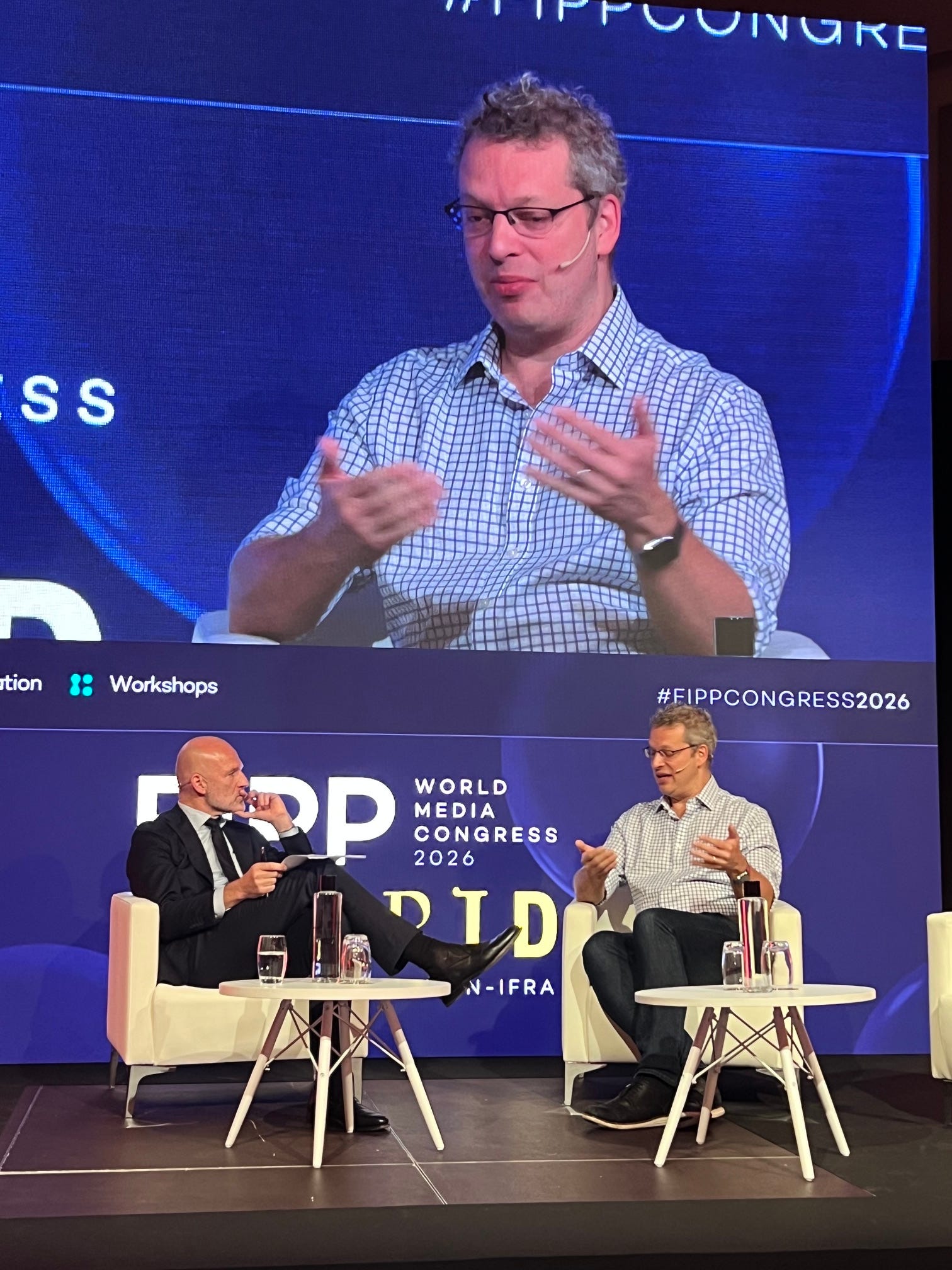
Jon Roberts opened his session in Madrid with a mathematical scenario. A person who searches for something reads one or two articles. An agent sent to answer the same question may read between 10 and 100. So, with no change in how many questions get asked, “we would be consuming 100 times more content,” the Chief Innovation Officer of People Inc. told Stig Ørskov, Chief Executive of WAN-IFRA, who chaired the session, titled “Getting Paid in the Age of Answers”.
The number of questions is not standing still either. Roberts argued that people using AI tools ask narrower, more specific questions than they ever asked before, so publishers need to produce new content to answer them, not just get paid for the content they already have. He described AI as a business with a supply chain. “AI needs chips. It needs power. It needs information.” Chips and power are well funded. Information, in his account, is the third pillar and the only one nobody is paying for.
“This isn’t for us a question about how we make ourselves whole,” he said. People Inc., the IAC-owned publisher formerly known as Dotdash Meredith, treats AI as a growth market and has a three-step method for entering it: block, get paid, then become a partner worth paying.
Blocking everything cost People Inc. nothing
Since January, People Inc. has blocked every non-human system that tries to reach its content, whether an ad tech bot, a Google crawler or anything else, with 38 exceptions covered by specific agreements. Roberts dismissed robots.txt, the voluntary protocol most publishers still rely on, as about as useful as a chocolate teapot. People Inc.’s content delivery network, Cloudflare, does the blocking using the same layer that repels denial-of-service attacks. Roberts said Fastly and other CDN providers now offer the same capability.
Ørskov suggested the company had simply accepted the hit to its reach. Roberts said there was no hit. “We lost no revenue, and we lost no traffic.” Advertising rose, “for some completely weird separate reason”. The block now turns away tens of thousands of unique bad actors and tens of millions of access attempts a day. “It is industrial, what is happening to your site.”
Some bots claim to be Google; others pose as readers, arriving through smart TVs and phones. People Inc. has taken its logs and screenshots to Capitol Hill as evidence of what Roberts called wholesale theft.
The case for blocking is mostly defensive: if someone is robbing your house, Roberts asked, why would you not lock the door? Blocking has also proven good for business. Licensed partners value that their rivals cannot get the same content for free, and some of the companies being blocked now contact People Inc. to ask how they can pay for access.

The test is whether a buyer builds a platform
Roberts sorts AI companies into two categories. “If you’re a parasite, we block you. If you’re a platform builder, we won’t block you.” In his definition, platforms create value that whole industries and economies can grow on; parasites extract it. The line can run through a single company: People Inc. admits Google’s search crawler and blocks Google-Extended, which governs use of its content in Gemini. “Search is a platform. Gemini is a parasite.”
Of the 38 permitted systems, the three largest deals are with OpenAI, Meta and Microsoft. The first two supply ChatGPT and Meta AI, with training allowances and licensed use inside those products. The Microsoft deal works differently: People Inc. is one of the publishers building Microsoft’s publisher content marketplace, which Roberts sees as a route to millions of buyers: any company that builds its own AI product and wants premium, rights-cleared content. He said the group’s health and finance titles are already in heavy demand from AI systems, because getting health information wrong is a mistake those systems cannot afford.
People Inc. also blocks the start-ups building marketplaces for scraped web content. One of them, Exa, raised $250m this year at a $2.2bn valuation. “Anybody who says there’s no money in content for AI is wrong,” Roberts said. Venture capitalists, he argued, do not put a quarter of a billion dollars into a single round unless a company has found its market. Exa has customers; what it lacks is suppliers.
Publishers are waiting for AI’s Spotify
He reached for the music industry. Napster took the product; Spotify, whatever one thinks of its terms, is a platform others can build on. Publishers have no equivalent for AI. When Ørskov asked whether he would rather be paid for access or use, Roberts said he did not mind much, provided a functioning marketplace emerges. The two models need different contracts, but either would give publishers a reason to invest. He reckoned the companies in the room could put at least a billion euros into new content if a platform justified it.
When Ørskov raised SPUR, the publisher coalition launched in Britain this year, Roberts agreed it was one of the groups trying to set the terms for that market. SPUR, he said, is in favour of an AI future, just not a parasitic one. His complaint is that the AI companies have shown no ambition to build the platform that would make such a market work.

People Inc. sells a better product than the scrapers take
Step three, being a good partner, is for Roberts a product question. Crawling, he argued, is a very bad way to get information. Most of the HTML built for human readers, he said, is useless to an agent. Pages are crawled only because the web is “kind of the USB connector of content”.
People Inc.’s alternative is an API that returns articles as Markdown, roughly 5% of the weight of the full page, which Roberts said makes them 95% cheaper for a model to reason over. Each piece carries clean metadata on when it was written and what matters. Latency is about 60 milliseconds, against seconds for a scraped page. Rights are handled at source: images are not sent, because People Inc. does not hold the rights to pass them on. “That’s not trying to tax AI companies,” Roberts said of the API, which People Inc. sells as a paid service rather than giving away. Only the earliest of the big partnerships still relies on crawling.

Small publishers have more leverage than they use
Ørskov’s last challenge was whether any of this works without People Inc.’s scale. Roberts conceded that no single publisher, however large, can shape the market alone. A specialist title’s content is harder to copy than a national’s, though, and that is leverage. “Do not think that because you are small you don’t have leverage,” he said. “You only have leverage if you start to use it.”
The first step is the one People Inc. has already taken: until a publisher blocks, the door is wide open. The second is to bargain collectively, through the RSL Collective, which backs the Really Simple Licensing standard, ProRata and similar groups.
Asked what publishers should do when they get back to the office, Roberts reached for the newsstand. Publishers, he said, are putting their product on the stand and letting everyone steal it. “Step one: stop them stealing it.”
Any publisher can block. Whether blocking ever pays depends on a marketplace nobody has built yet, and Roberts can't offer a date for when AI companies will get around to it.