



UK advertising grew 11.0% in the second quarter of 2026, to £12.3bn. In July, the AA/WARC Expenditure Report had forecast 8.9% for the World Cup quarter; the market beat that by two points and outpaced the 9.3% recorded in the first three months of the year.
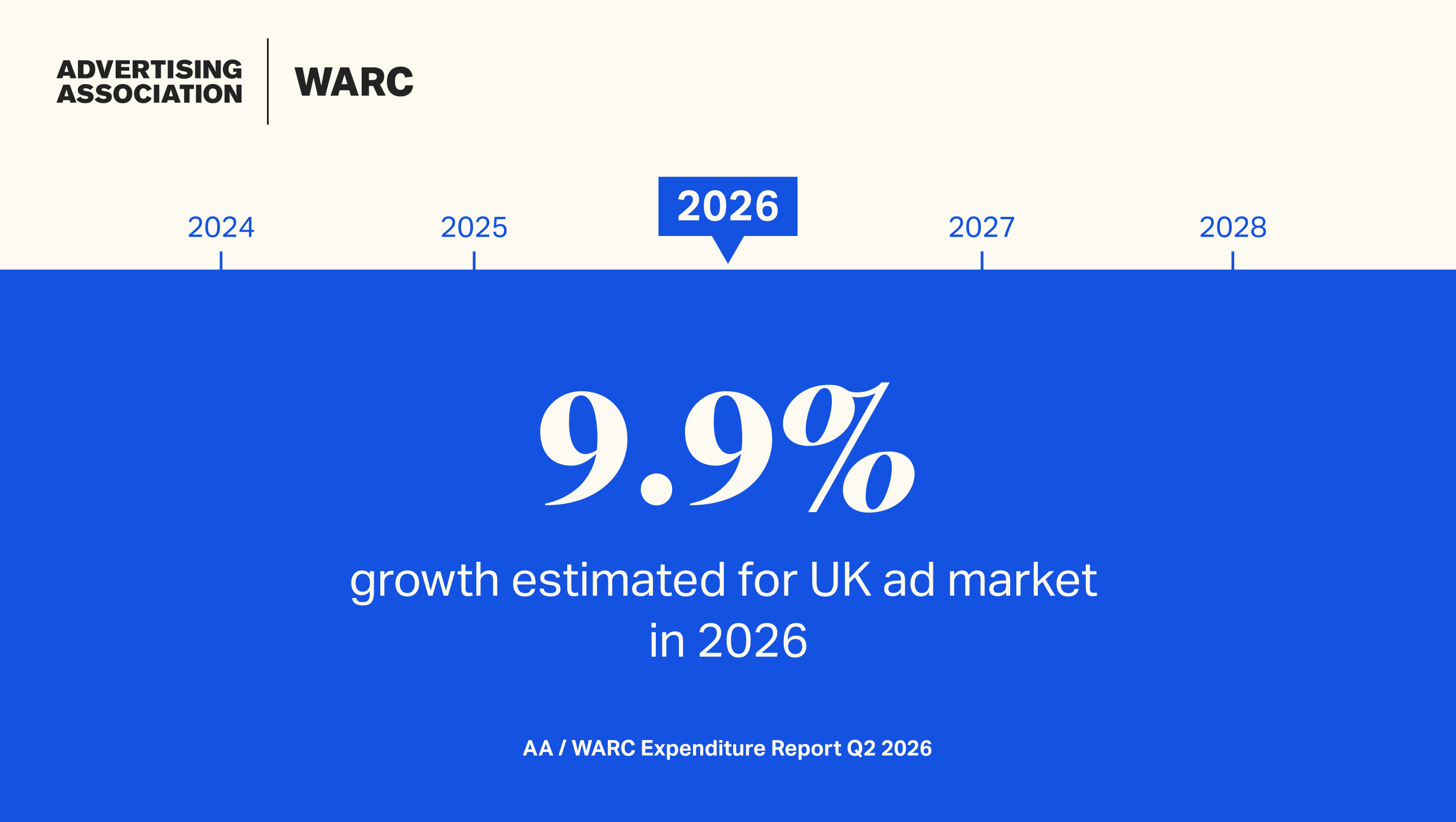
The full-year forecast rises again to £51.3bn, a 9.9% increase on 2025 and 1.8 percentage points above July’s estimate. The festive quarter is expected to bring a record £14.0bn, up 8.2%, or £1.06bn more than last Christmas.
Those are the figures the Advertising Association leads with. The table below describes a market moving at two speeds, and the slow lane is where publishers and broadcasters are.
Retail media and cinema set the pace
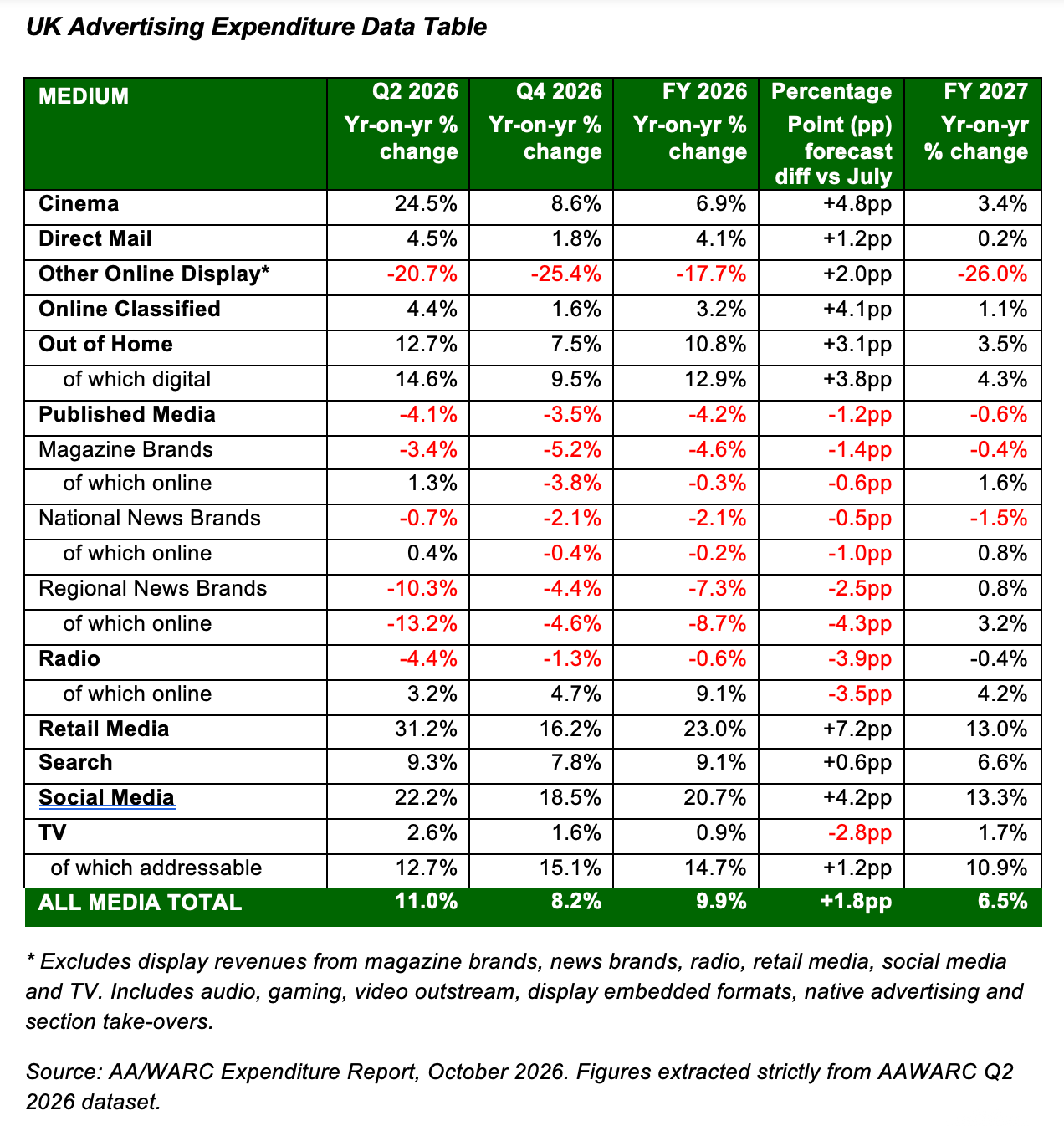
Retail media grew 31.2% in the quarter, up from 17.9% in Q1, and now takes 8.4% of all UK advertising, roughly £1bn in three months. WARC has raised its full-year forecast for the channel by 7.2 percentage points to 23.0%, the largest upward revision in the dataset. Social media grew 22.2%, against 17.7% in Q1, and its 2026 forecast moves up 4.2 points to 20.7%.
Cinema grew 24.5% on the strength of The Devil Wears Prada 2, The Super Mario Galaxy Movie and Toy Story 5, and its full-year forecast rose 4.8 points. Out-of-home rose 12.7%, with digital screens up 14.6%. Addressable TV also rose 12.7%. Search, still the largest single channel, grew 9.3%, marginally slower than in Q1 and no longer among the leaders.
Suzy Young, WARC’s Head of Media Data, attributes the quarter to more than football. Growth “was boosted by the FIFA World Cup, but increasingly reflects AI investment, as platforms enhance targeting while both new AI-native companies and established tech firms compete for customers,” she said. “This AI-driven boost is especially pronounced in the UK, given the maturity of its digital advertising market.” It came, she noted, “despite geopolitical headwinds and weak consumer confidence linked to the Middle East conflict.”
The revisions say more than the growth rates
The column comparing October’s full-year forecasts with July’s is the clearest statement of where the money is going. The upgrades are in platform, performance and experiential channels:
The open web is shrinking fastest of all
Other online display covers audio, gaming, outstream video, native advertising and display formats sold outside the platforms and the major media owners. It fell 20.7% in the quarter, and WARC expects a 17.7% fall this year followed by 26.0% next. Compounded, that market loses around two-fifths of its value across 2026 and 2027.
Published media fell 4.1%, an improvement on the 5.9% decline in Q1. National newsbrands nearly held their ground, down 0.7% in total, with online revenues up 0.4% after a 0.8% fall in Q1. Magazine brands fell 3.4%, with online up 1.3%.
The regional newsbrands are a different case. Total revenues fell 10.3% and online revenues fell faster, by 13.2%. In a quarter when social media grew 22% and retail media 31%, the regional press’s digital business shrank by more than its print business did. Its full-year online forecast has been cut by 4.3 points, the deepest downgrade of any line in the table.
Radio fell 4.4%. Digital radio, which grew 22.1% in Q1 and was then the fastest-growing line in the dataset, managed 3.2%, and loses 3.5 points on its full-year forecast. TV grew 2.6% in total, with addressable doing the work at 12.7%; the full-year TV forecast is now 0.9%, down 2.8 points.

Subscribers of The Media Stack can save 15% using this code:
NRS26MEDIASTACK
Christmas will not change the pattern
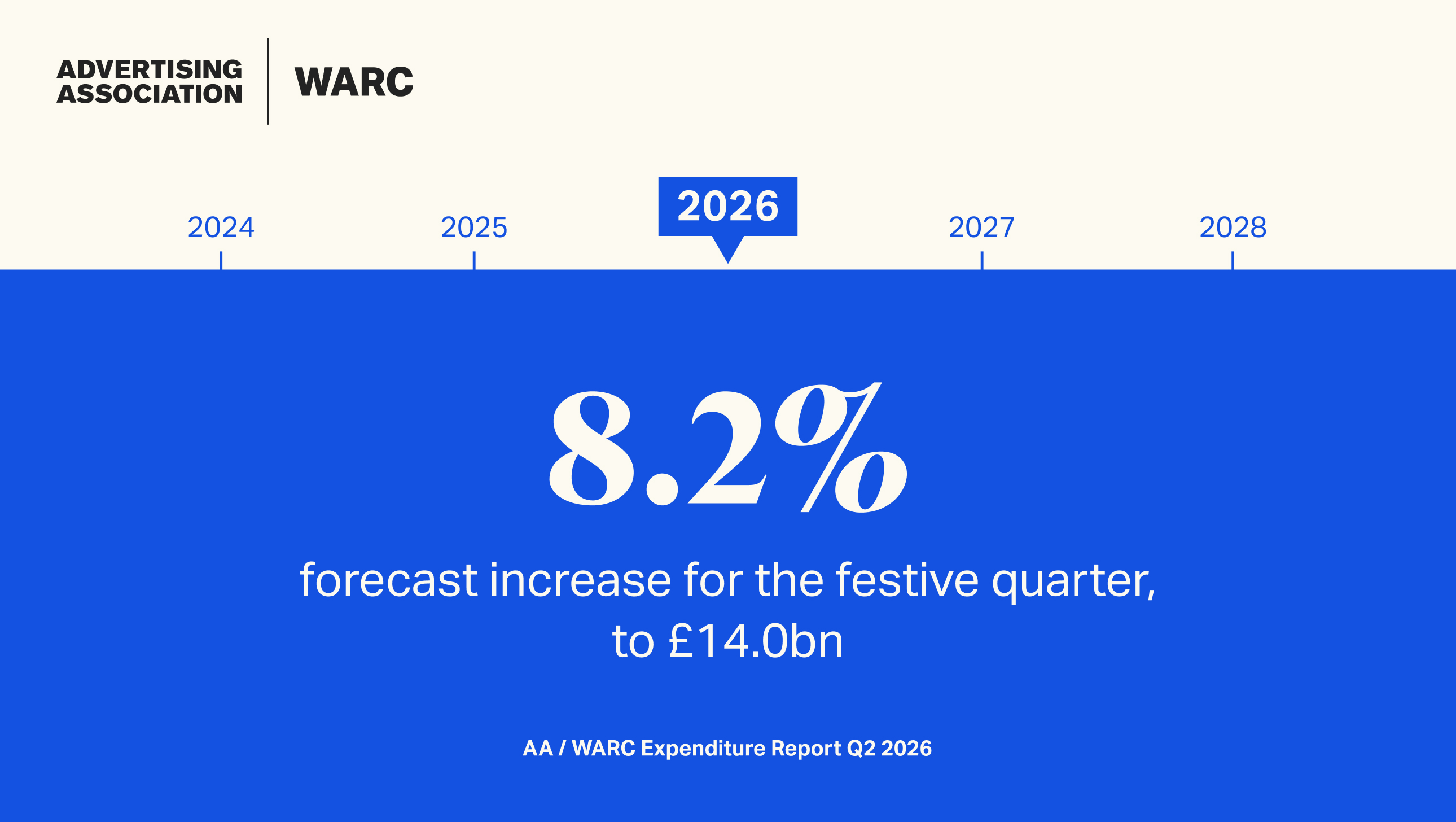
The golden quarter, the October-to-December trading period, is forecast at £14.0bn, up 8.2%. The channels expected to lead:
Social media: 18.5%.
Retail media: 16.2%.
Addressable TV: 15.1%.
Cinema: 8.6%.
Search: 7.8%.
Out-of-home: 7.5%, helped by high-street footfall.
“The £1.06bn increase underlines the vital role advertising plays across all channels and media formats in supporting business growth during the golden quarter and beyond,”
Stephen Woodford, Chief Executive of the Advertising Association.
Published media is forecast to fall 3.5% over Christmas, and it is not the only line going backwards:
Magazine brands: down 5.2%, with online revenues down 3.8%.
Regional newsbrands: down 4.4%.
National newsbrands: down 2.1%.
Radio: down 1.3%.
Other online display: down 25.4%.
2027 brings slower growth and a first sign of a floor
Growth moderates to 6.5% in 2027, taking the market to £54.7bn. Social media (13.3%), retail media (13.0%) and addressable TV (10.9%) still lead. Published media’s decline narrows to 0.6%, and the forecast has the regional newsbrands returning to growth, by 0.8% in total and 3.2% online. Magazine brands are close to flat at -0.4%, with online up 1.6%. National newsbrands are still forecast to fall by 1.5%, with online up 0.8%. Other online display falls a further 26.0%.
Advertising has found its growth, and it is buying it from retailers’ ad networks, social platforms and AI companies competing for customers. The regional press will end 2026 with its online revenues down 8.7% and, on WARC’s forecast, return to online growth of 3.2% in 2027.