

SAP’s headline from its 2026 Global Customer Loyalty Index is that rewards-based loyalty has fallen below 40% for the first time in the survey’s six years, from 48% to 38%.
Part of that fall may reflect a change of sample. Last year’s survey covered the US, UK, Germany, Australia and Taiwan; this year’s 10,002 respondents came from the US, UK, Germany and Hong Kong. SAP does not publish the rewards figure by country, so the effect cannot be checked, but in the three markets surveyed in both years overall loyalty barely moved, rising two points in the UK to 69% and falling two in the US to 71% and one in Germany to 65%.
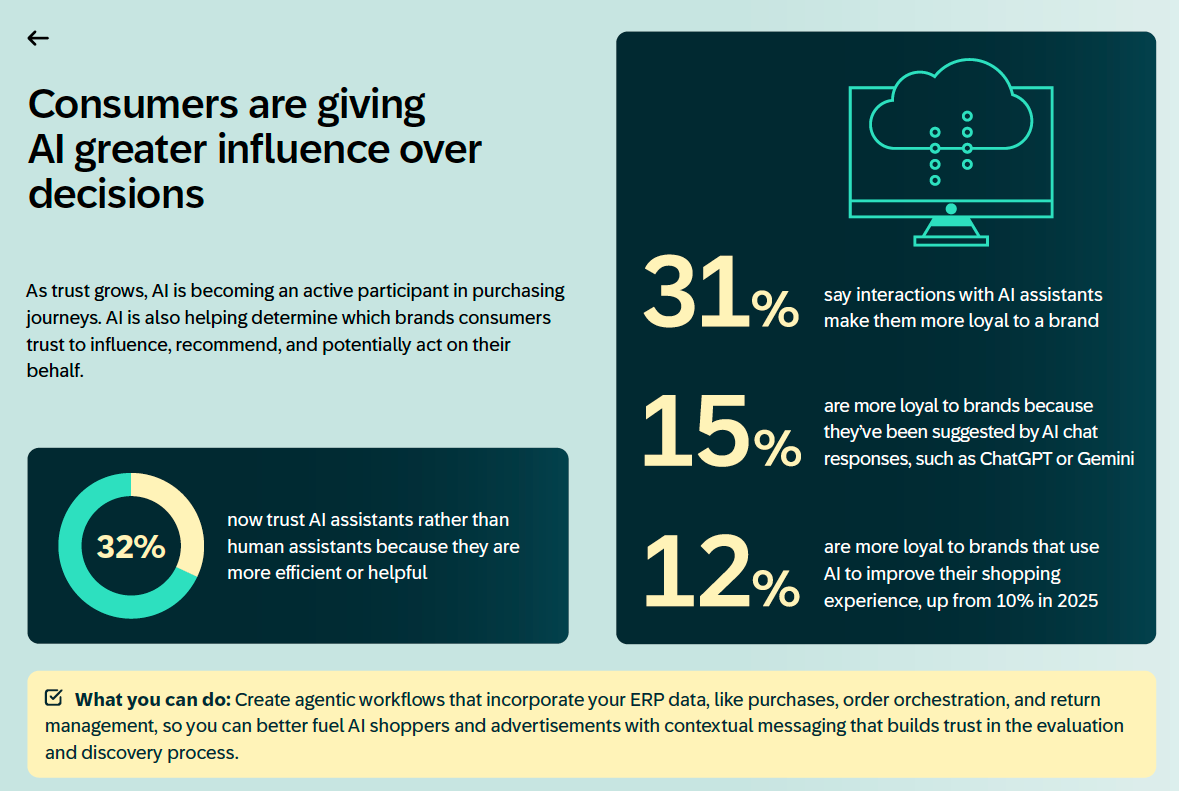
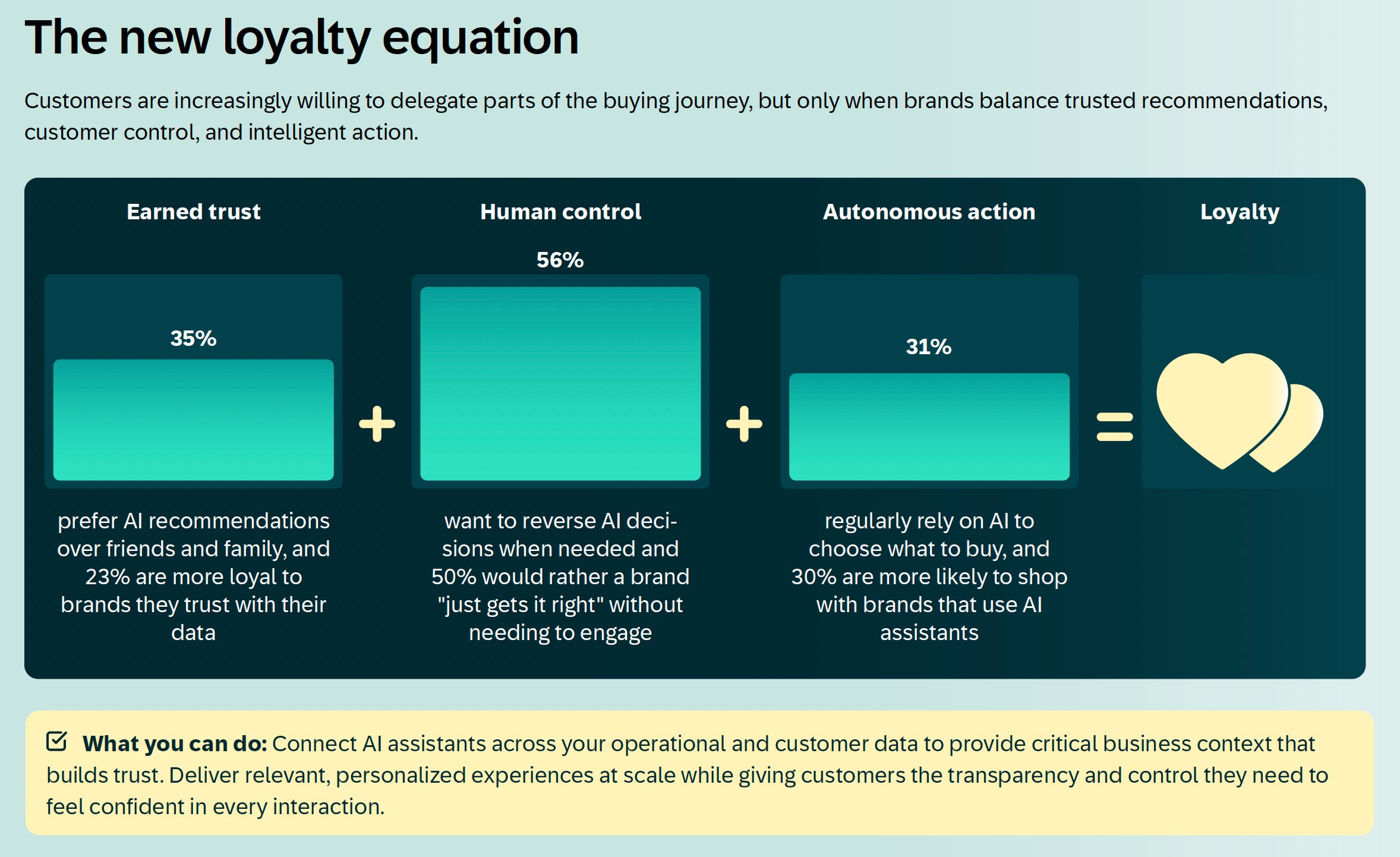
The report, published last month by SAP Engagement Cloud (formerly Emarsys) and fielded by Opinion Matters, is more useful on a question that doesn't depend on last year's sample: who is making the recommendation. Some 35% of consumers say they prefer AI recommendations to those of friends and family. In the US, according to SAP’s announcement, the figure is 44%.
A companion survey of 2,295 enterprise technology buyers, the Global B2B Buyer Loyalty Index, finds that 69% would switch supplier if an AI agent found a better option.
Shoppers are letting AI do the recommending
Across all consumers surveyed, 38% use AI to help make purchase decisions and 33% have bought a product an AI recommended. For 15%, a suggestion from a chatbot such as ChatGPT or Gemini has made them more loyal to a brand. Fewer now say they show loyalty by recommending a brand to friends and family: 42%, down from 48%, though that comparison carries the same sample caveat. SAP’s “silent loyalty” category, customers who stay with a brand they would not endorse publicly, covers 58%, the highest share in the series, though on the new sample.
Paying for subscriptions, which SAP counts as a loyalty signal, rose from 14% to 17%, and engaging with brand content from 17% to 21%, subject to the same caveat. The report advises consumer brands to cultivate both, which sets them chasing the habits subscription publishers have spent a decade trying to build.
SAP also reports that 78% of consumers who use AI to shop consider themselves loyal to brands, against 69% overall, and presents this as evidence that AI strengthens loyalty. AI shoppers are also more than twice as likely to describe their loyalty as trend-driven (21% against 9%). People who shop with AI may simply be keener shoppers to begin with, and the survey has no way of telling the two apart.

Consumers want AI to shortlist and a human to call when it goes wrong
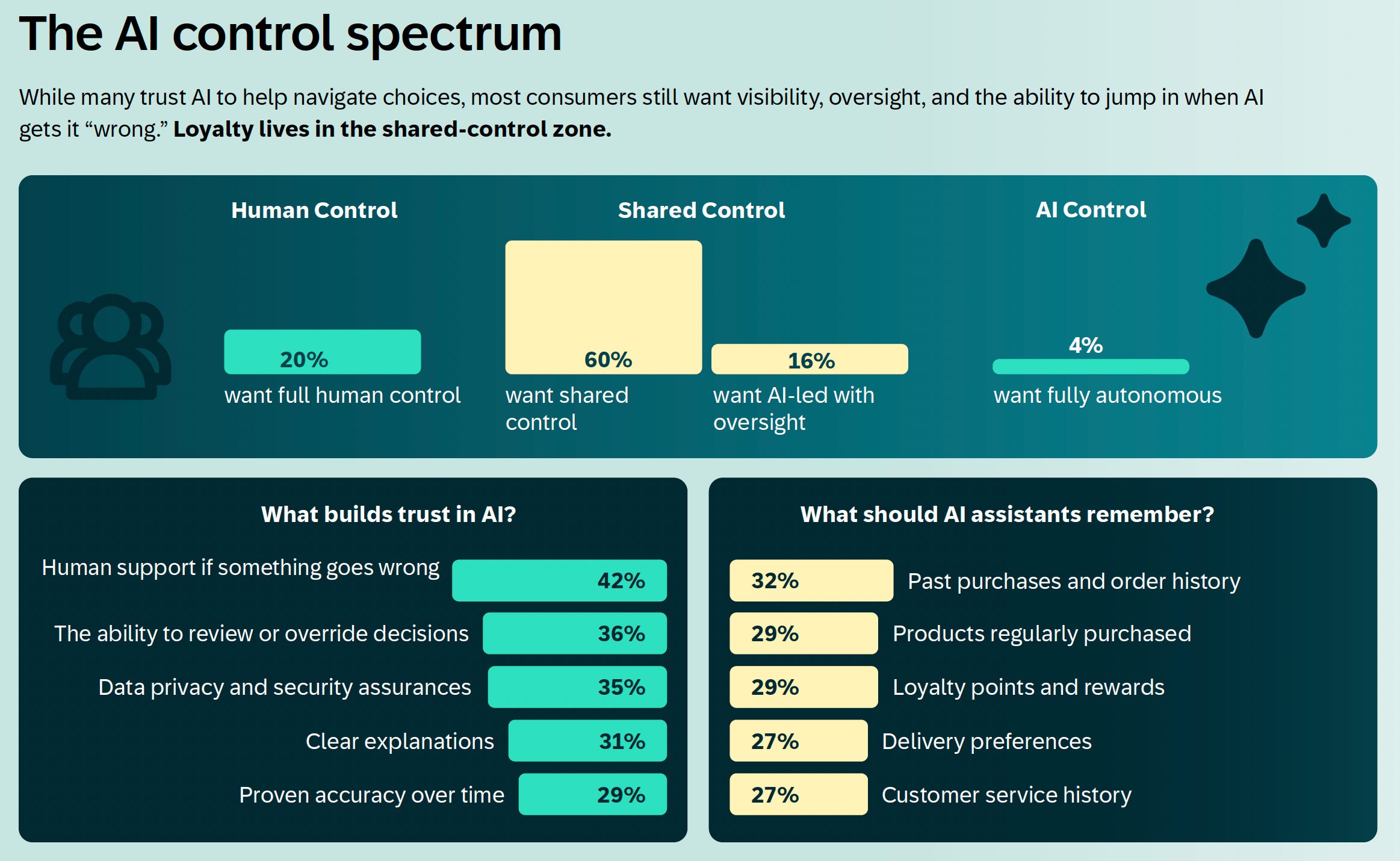
On SAP’s “AI control spectrum”, only 4% of consumers would accept fully autonomous purchasing, while 60% want shared control with the AI, 16% would let it lead under supervision and 20% want to keep full control themselves. More than half (56%) want to be able to reverse an AI’s decision, and 48% want a human to be available, although 50% would rather a brand simply got it right without their involvement.
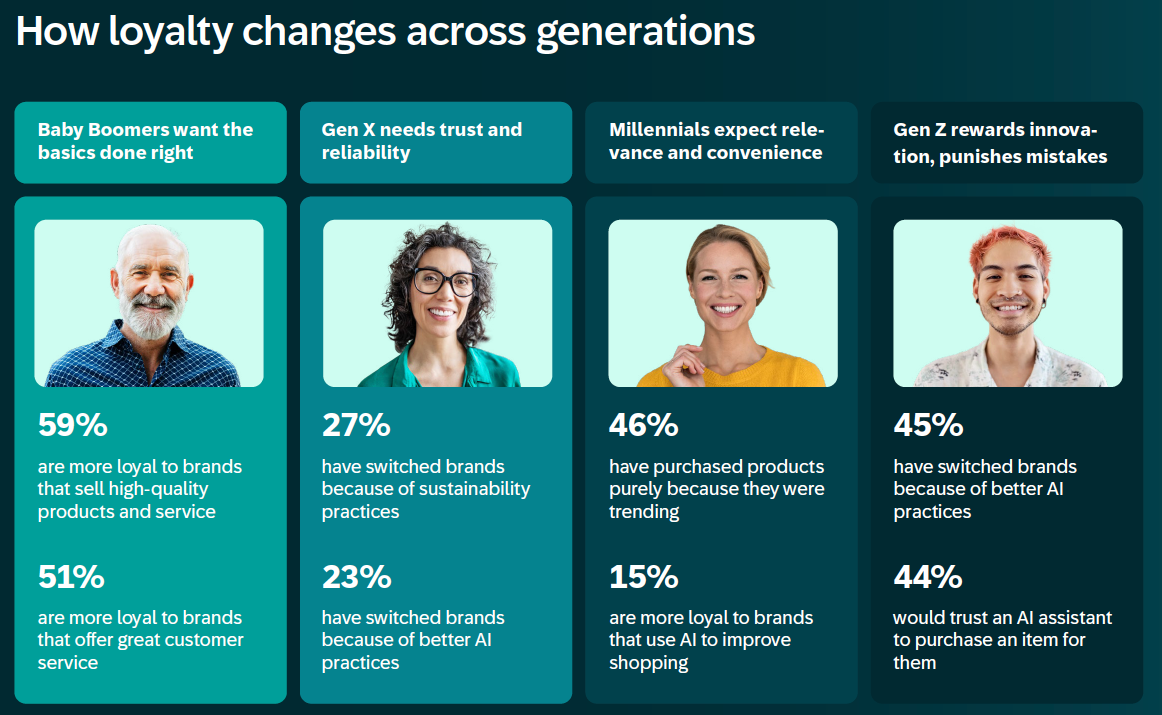
Gen Z is the most willing to delegate: 44% would let an AI assistant buy for them. It is also the quickest to walk away: 45% have dropped a brand over AI, against 30% of all consumers and 23% of Gen X.

Why is less clear, because SAP explains that 45% in three different ways. Its key findings put it down to “their use of AI”, suggesting AI steered them towards other brands. Its generations page cites “better AI practices” by rivals. Its press release blames brands’ own use of the technology.
Mark Ritson, founder of the MiniMBA, a former marketing professor and a columnist for The Drum and AdWeek, took the view in SAP’s announcement, saying the cohort is “proving to be the least forgiving when brands get it wrong”.
Enterprise buyers would let an agent end a supplier relationship
In the B2B survey, 77% of buyers consider themselves loyal, up from 71%, with the UK rising furthest, from 69% to 78%. That sample changed too, from 3,008 buyers in five markets to 2,295 in four. Much of the loyalty looks like inertia: 64% agree that switching supplier is too complex and expensive.
Yet 69% would switch if an AI agent found a better option, and 71% would trust AI to choose the most popular option over automatically renewing with an incumbent. Some 78% are comfortable letting AI handle routine purchases on their behalf, against 33% of consumers who trust AI to complete a purchase. Business buyers’ most-cited condition is a human fallback, required by 34%, and 72% expect discounts to matter less as agents take on more of the buying.
AI is becoming the first stop for supplier research
Among the enterprise buyers surveyed, 71% use AI to research or shortlist vendors, and 30% say an independent AI system was their most common source for researching suppliers this year. Some 88% trust AI-generated supplier recommendations, although only 37% trust them completely. That leaves most buyers with reason to check the AI’s answer, and an opening for a trade title they trust.

Supplier research is what B2B publishers sell to technology vendors: an audience of buyers who are still deciding, reached through advertising and events. If nearly a third of those buyers now rely mainly on an AI system, vendor budgets are likely to follow them there. SAP is already telling suppliers to make sure the material those systems read about them is accurate and consistent. Tom Goodwin, a marketing expert and author, quoted in the report, argues that brands “become more important” as AI takes on purchasing decisions, because reputation is what makes a recommendation credible. Trade publishers have that reputation. Few have found a way to be paid for it when the reader is an AI system.