



Steve Davies knew a story was coming. When he spoke to The Media Stack, the Chief Executive of the Advertising Producers Association had been told that news about one agency group’s in-house ambitions was imminent. A journalist had it. He could not discuss it. Within the week Campaign published extracts from internal WPP Production guidance telling staff to “actively convince” clients to send all their production work to WPP and, where a client insisted on three bids, to consider supplying all three from inside the group. The stated goal was to avoid traditional triple bidding by “positioning WPP Production as the default, trusted partner”.
The APA called it “a brazen attempt to pull the wool over their clients’ eyes”. WPP said the extracts were selectively quoted from a comprehensive document and that its process is completely transparent. Within a fortnight, Campaign reported that the document had been taken down. WPP declined to comment on its removal. The argument is still running, and Davies had made his side of it, at length, before there was a document to point at.

“The same person turning up in a different outfit every day”
Davies runs a trade body for around 250 independent production, post, editing, music and sound companies, and he doesn't ask for protection from the market. “Red hot competition is just part of the world we live in, so we can’t complain about that,” he said. When an agency takes a script to three production companies and the directors it wants, they compete on treatment and price, and the client can go back to its favourite and ask it to match the cheapest. “The client’s got all the power. I don’t think clients ever need to worry about value. The market delivers value.”
What he objects to is distortion. Agencies are entitled to build production units, he said, but an in-house unit that hires three freelance directors, assembles three treatments and presents the client with a choice is not running a competition. “That’s not an open market competition. It’s the same person turning up in a different outfit every day, saying you can have me, or me, or me.” A genuine triple bid involves three companies with no connection to each other. He has been saying so since the IPA’s 2024 client research; the leaked document briefly put it in writing.

The withdrawn guidance went further. According to Campaign, it proposed that every production below €500,000 go directly to WPP Production, and that where a client still insisted on an external triple bid, staff should either take part with safeguards, presenting WPP’s proposal before outside companies were briefed, or stay out and work on the client’s procurement team instead. Campaign also reported unease among WPP’s own staff at being asked to abandon trusted third parties.
WPP disputes the reading. James Brook-Partridge, Head of Production at WPP Production, said there are no mandates to internalise work and that the driver is volume: clients make three times as much content as three years ago and may need five to twenty times as much within two, on the same budgets. The IPA’s Eliot Liss said it was untrue that agencies pass off internal bids as independent ones.
The order comes from the finance director, not the creative floor
Why now? “They often don’t have clients on retainer any more,” Davies said, “and in the case of some of the groups, they have a precipitous decline in their share value, so they’re doing anything and everything to keep revenue within the door.” WPP, on its figures, has fallen from £18bn to £4bn. It exited the FTSE 100 in December and in February reorganised into four units, one of them WPP Production.
“Professionalism is putting your clients’ interests first and before your own, and this isn’t that,” he said. “It’s putting your own short-term interests first.” A client denied an open market will eventually notice, he argues, and go elsewhere. “But the reality is that some of these groups are so desperate there is no long run.”
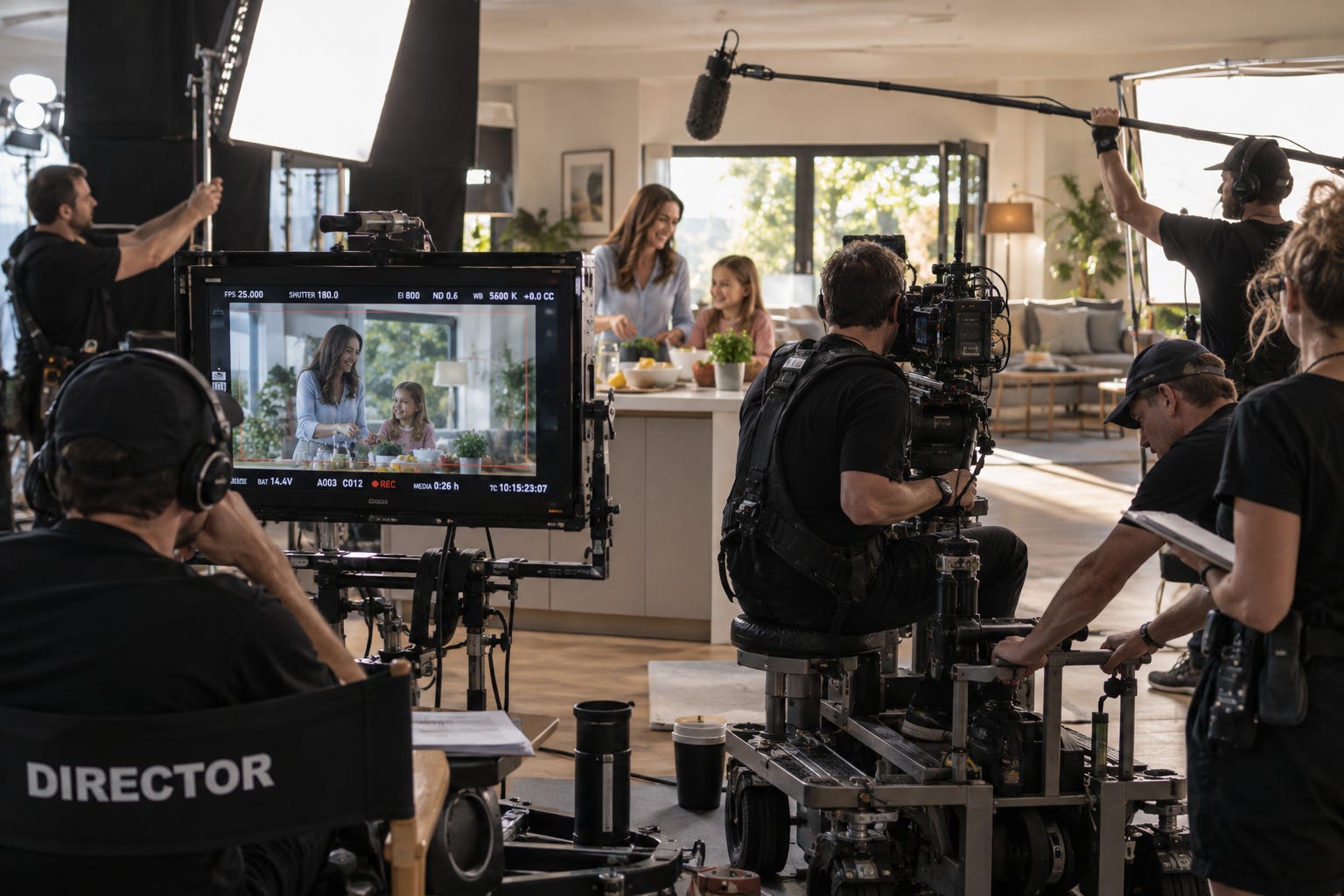
The pressure, he said, doesn't come from the people who do the work. “The production and creative departments want to work with the independent sector, because they know that’s where the talent lies. It’s usually the C-suite, simply the Chief Financial Officer, who makes rules that you must do a certain amount of work in-house.” Creatives who push back, he said, are told to comply. The best directors, editors and producers stay in their own companies because they want a variety of work. “They don’t just want to work inside some sort of monolith for one or two clients.”

Half the money never touches an agency, let alone a production company
In-housing is one reason scripts have stopped arriving at independent companies. It is not, Davies said, the largest. “Every year for the last few years the ad spend in the UK has been up significantly, and yet nobody within a production company or indeed an agency has noticed that, because more than half of ad spend now goes directly to Meta, to Google or to Amazon without touching an agency or production company.” In-housing bites hardest in the middle of the market; the media shift does the rest.
He rejects the IPA’s 2024 explanation that agency studios grew because the traditional production market was under-serving the explosion in digital work. “The independent market has always had the capacity to make all the work that they can get their hands on. I don’t think there’s any evidence to suggest that it was a reaction to a lack of supply. It was a reaction to the agencies’ own problems.”

AI gets a film to 85%. The last 15% can cost more than a shoot
“AI can often make something that’s 85% good as a film extremely quickly, in a way that just wasn’t possible before,” Davies said. “When you look at it, you think, wow, that’s astonishing. But getting it from 85 to 100% can often take more money and be more difficult than if you shot the thing from scratch.”
He saw a set of AI awards recently. “On the face of it, the work was astonishing, but none of it was capable of evoking any human emotion.” Clients still arrive at production companies asking to make “something in AI”, often, he suspects, because a marketing director needs to look current. One producer told him his answer is that he will decide how far AI helps once he knows what he is making. “It’s just another production tool, really.”
Life beyond the TV script
Asked how many production companies the industry can support, Davies would not put a number on it. “There are probably fewer production companies that can exist on TV scripts. But there are plenty of companies within the APA now who never make a television commercial. They’re nimble. They get out there and make things constantly for Instagram, other online content, and that world is expanding. Our capacity as humans to view more audiovisual media seems to grow every year.”
The other opening is that clients no longer route everything through an agency. “We had one model in the past: client to agency to production company. We’re not moving to a second model. We’re moving to a thousand different answers.” Some clients work direct; some keep an agency but insist on a genuine triple bid; some don’t care much as long as the work gets made.
Davies has run the APA since 4 June 2000, a date he now quotes to members who were not born then. A former law-firm partner, he still reviews members’ contracts himself. His public line on the WPP document was that it threatened the independent sector only if clients failed to see through it, and that he thought they would. The document has now gone, without explanation, and WPP Production opens its east London flagship this week, built for the content volumes Brook-Partridge says clients now need. Whether the three bids for that content come from three companies or one is still a decision for the finance and procurement departments that, on Davies’ telling, have been steering the work in-house.