



“My mum was my school dinner lady. I had no industry connections.” Rachel Duffy grew up in Middlesbrough, where the industry felt out of reach; even Manchester and MediaCityUK seemed remote. Everyone she met on the way in seemed to have found work experience through someone they knew, or an uncle at a newspaper. She had a history and international relations degree, a university paper, some freelance social media work, and a plan.
On paper, the route she took looks clean: an NCTJ (the National Council for the Training of Journalists qualification) at News Associates, writing for the Londoners, then a job as Social Editor at The Telegraph found on LinkedIn. “It’s not something I advertise, but I applied for about ten different grad schemes and entry-level roles at most of the nationals. I didn’t get an interview for one.” Beyond the grad schemes were 50-plus applications to anything journalism-adjacent, most of which went unanswered. Some answered eventually.
“There were a lot of jobs that I heard back from many months after applying, by which point I had already been at the Telegraph for a while.” That, she says, “felt like salt in the wound”.
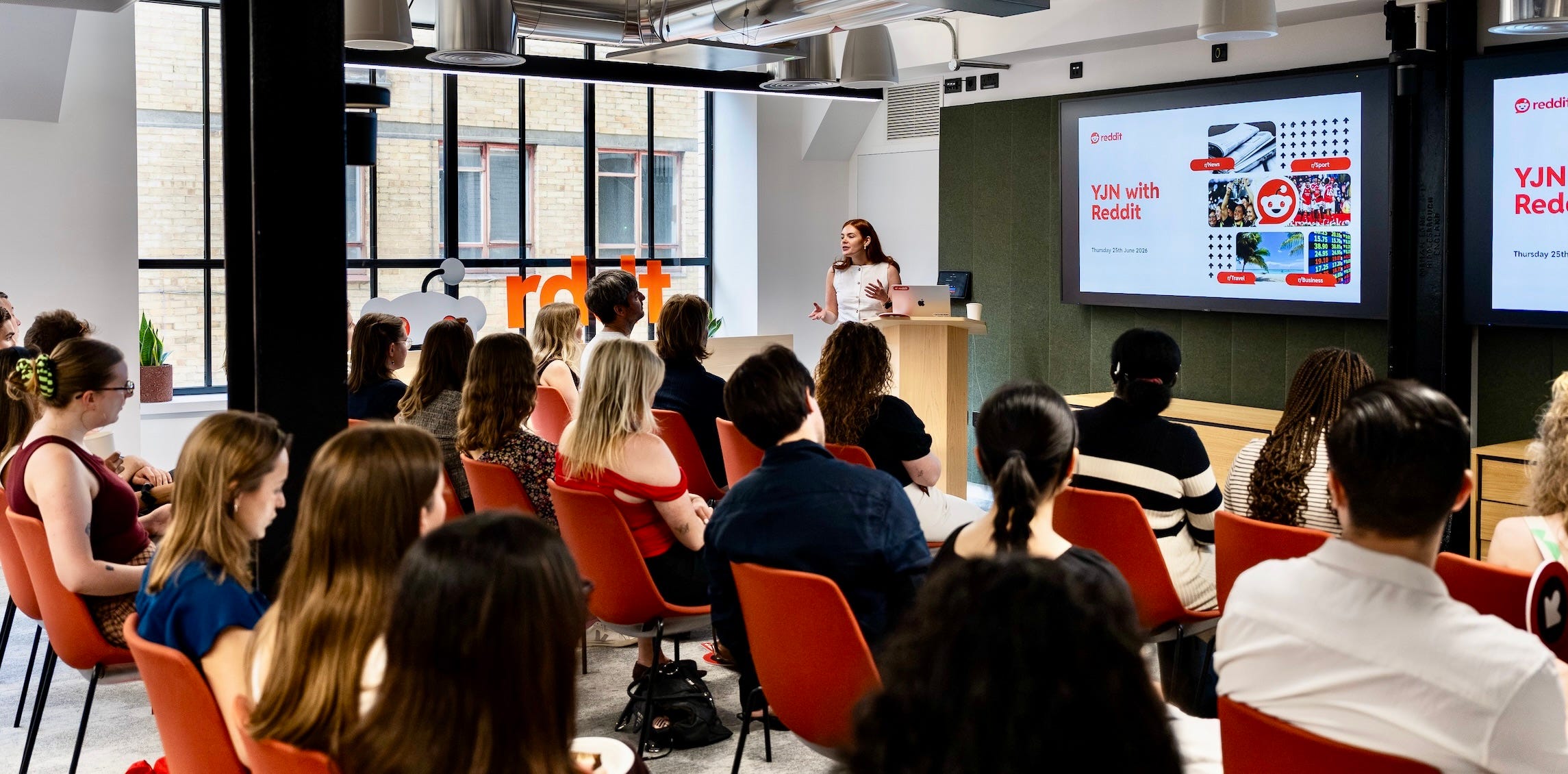
Rachel Duffy presents at the Reddit HQ
Duffy is now Head of Community at The Times and Sunday Times. The Young Journalist Network, which she founded and still runs, exists because of the gap between how simple her route looks in hindsight and how opaque it felt at the time. It operates under the founding principle that “Access and opportunity, not luck,” will sustain the next generation of journalism. “I didn’t know what qualifications were needed or what a good way in looked like. I would have loved to have a conversation with someone who was in the industry at that age. YJN tries to alleviate some of those stresses and unanswered questions, pairing young talent with someone that they can have those conversations with.”
Getting in is one problem; staying in is another
YJN runs in two distinct parts. The first serves undergraduate and postgraduate students trying to get in: CV and cover letter reviews, grad scheme application support and plain answers to questions the industry assumes everyone already understands. “People are throwing around these terms like NCTJ. So many people don’t know what they actually are or exactly how helpful they are.” Should I do an NCTJ? Should I go to City? The network has partnered with universities to field exactly those questions.
The second part is retention: monthly events for people already in the industry, mostly under 35, a generation that arrived after the post-work pub culture that once did the industry’s informal networking has thinned out. “It’s a very gruelling industry,” she says. “The shifts are brutal.”
Her case for the events is blunt. YJN aims to bring ‘traditional’ competitors together because, as an industry, she believes we are guilty of “Becoming a little too caught up in competitors. Really, the competitors are TikTok, Disney, Netflix, fake news, disinformation, AI, rather than The Times, the Mail, the Guardian and so on. So we offer a space where people can come together to skill-share, knowledge-share, and just have a glass of wine. Some people come with their colleagues and use the opportunity to speak frankly outside the constraints of the office, while others come alone and speak only to people from other organisations. Maybe they’re trying to get a job elsewhere. I don’t pass judgement as everyone is welcome.”
When Reddit became the platform that publishers started to get interested in due to its deals with Google and LM’s such as Claude and OpenAI, YJN took its members directly to Reddit’s offices to ask how journalists should be using the platform, including how they should use it to source stories as well as ways to market themselves.
The Reddit event ran on a Wednesday afternoon, the kind of thing Duffy would have historically taken a half-day’s leave to attend. “Publishers were saying no, you take that as an offsite day; that’s really good training.” That, as much as any placement statistic, is her measure of success, one she concedes needs formalising. “That they understand what the difference between a diploma and a Master’s degree in journalism is, what a realistic entry-level salary in London is. Asking those questions that they maybe can’t ask parents or peers is how I measure success, not just purely on placements and jobs.”


The credential behind the network: communities over follower counts
Duffy’s day jobs are the reason publishers take her calls. At the Telegraph, where she rose to Deputy Head of Editorial Community and was nominated as a Rising Star at the AOP Digital Publishing Awards last year, her brief was reader retention: persuading journalists to spend twenty minutes below the line, mining the comment section for stories worth flagging to desks, getting reader questions answered on podcasts. Engaged readers, she argues, “become more loyal, and they also become advocates for your journalism. You’re not having to pay a marketing company or influencers to speak about your journalism. You have this amazing, powerful community of readers that are doing that for you.”
It was also where she built the Reddit expertise she discussed on a panel at newsrewired earlier this year. The Telegraph saw the platform as a route to a huge, largely American audience it could not reach on follower-driven networks dominated by the New York Times, the Washington Post, the Wall Street Journal, etc. On Reddit, she says, “it’s not about follower counts; it’s about communities”: the first account to post a major breaking story takes the traffic, whatever its karma. “In real terms, if done well, it’s a real win for referral traffic and page views. And I think that’s what a lot of publishers are coming around to now. Maybe a little late to the party, but good that they’re there.”

At The Times, the principle is the same at a larger scale. For this summer’s World Cup, her team (she credits Sifa Manara with the strategy) built a WhatsApp group of Times and Sunday Times readers travelling to the United States, Mexico and Canada. Those readers fed directly into the live blogs, sent pictures and voice memos when England and Scotland scored, and reported what it was like on the ground at the stadiums. Previously, she says, community journalism might have amounted to one article on Times readers going to the World Cup; this ensured that readers were at the heart of all editorial content and featured on The Game podcast.

The jobs that AI removes are the entry-level ones which they would have taken
The difficult backdrop is that many publishers are using AI to automate stories that would traditionally have been done by entry-level and trainee journalists. Bauer Media’s women’s weekly “Take a Break” recently stopped freelance commissions in favour of content written by AI; these are exactly the sort of jobs that typically would have been done by junior teams. Duffy does not dispute the threat.
“While AI is maybe removing some of those entry-level jobs, it’s also creating other roles that wouldn’t have existed previously,” she says, and wants AI literacy taught in schools, universities and training courses. Reddit, she notes, is “probably surfacing your work for you already” in LLM answers; understanding how is now part of your job.
She also highlights that the picture isn’t the same across the board. The Times aren’t removing any editorial entry-level jobs due to AI.
The access problem has not waited for AI. “I honestly think that anywhere more than an hour out of London is very, very difficult. It’s not even geography; it feels culturally very far away.” Entry-level roles have reached a gender-equal split, she notes, but senior roles are still predominantly dominated by men, and representation of BME (Black and minority ethnic) journalists, disabled journalists and regional voices is poor: “The numbers aren’t where they need to be or where they should be.” YJN points people to organisations such as the Journalists’ Charity and Women in Journalism, the former helping to fund travel to London interviews.
Bootstrapped, and choosy about the money
For its first 18 months, YJN was entirely self-funded, and Duffy turned down money. “We’ve had offers from a few companies, including some crypto ones, but it just doesn’t align with what we’re building.” The first significant partnership arrives on 25 August, when Qwoted hosts the network’s summer party at its offices. An agreement with Women in Journalism has also given YJN a regular newsletter slot and Duffy a place on their Committee. YJN will go international next month with its first event stateside, at Columbia Journalism School in September. The ambition is a YJN “wherever there’s a hub of young journalists that need support”, in the UK regions and beyond.
About 70% of her members want to be journalists in the traditional sense; 30% want the business side. Duffy’s own career suggests the line between the two is thinner than the job ads imply. “I didn’t know that my job existed five, ten years ago, but it’s so important to journalism. I still regard myself as a journalist; I curate stories and connect with audiences and people in new ways.
That is the double shift she has signed up for: keeping readers inside the industry’s paywalls by day, and holding its front door open on evenings and weekends.
