



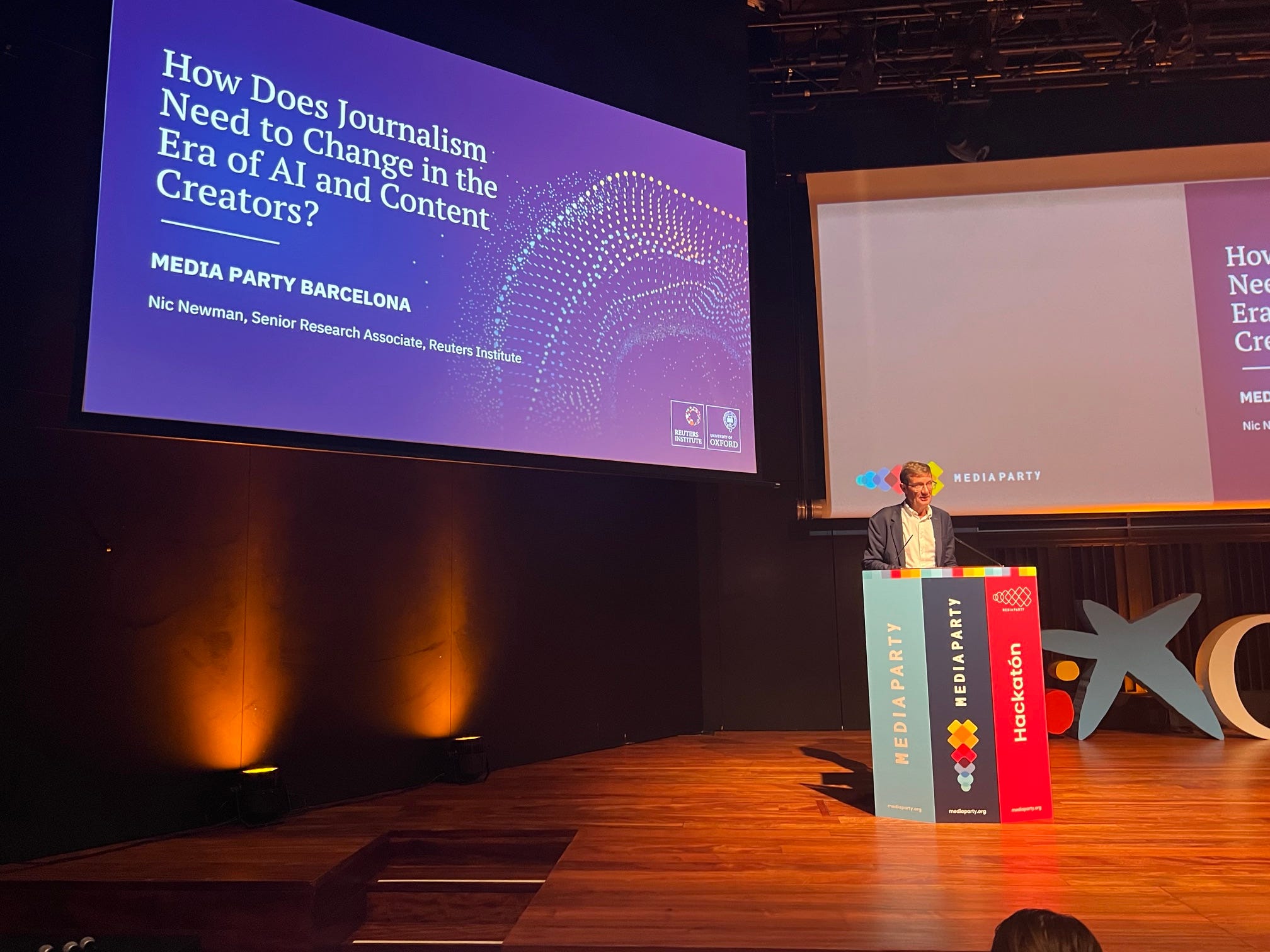
Nic Newman opened his Media Party session with a heatwave warning. During the worst of the summer, he had put a handful of questions to Claude. Back came a sourced Q&A, a temperature chart, an energy-mix chart by country and a list of the hottest spots, then the same again in Spanish. “It assembles this information very quickly. Assembles it essentially as a service,” the Reuters Institute’s senior research associate told the room. “From a publisher point of view, of course, this looks more like an existential threat.”
Later in the morning Dmitry Shishkin opened his session with a sentence. “It doesn’t really matter what you do with AI. If your content is crap to start with, then you are not going to succeed.”
Though the programme listed them as separate sessions, the two amounted to a single argument delivered in halves. Newman had the stats: where audiences and referrals have gone, and where publishers say they are placing their bets. Shishkin, the former BBC editor behind the user needs model, had the case that those bets cannot be paid out by newsrooms whose editorial, product and data systems do not talk to each other.
The referral era ended between two Novembers
Newman’s opening chart, aggregated across the 48 countries of the Digital News Report 2026, showed social media overtaking television as the most important source of news for the first time. He was more interested in a line lower down. “Access to news websites and apps are down 12 percentage points since 2021, as people find new and more convenient ways to access the news.” Across countries, 10 per cent now regularly use chatbots such as ChatGPT or Gemini for news.
The supply-side data was worse. Publishers surveyed for the Institute’s trends report at the start of the year expect to lose around half their traffic over the next five years as content is absorbed into AI interfaces. Chartbeat data covering some 2,500 sites shows Google referrals falling by about a third between November 2024 and November 2025, a decline Newman said was not universal and not wholly down to AI Overviews and AI Mode. “The key story is that publishers won’t be able to rely on referral traffic in the way that they have done in the past.”


Publishers have chosen distinctiveness. Shishkin asked whether they can measure it
Asked where they would put more and less effort, publishers gave Newman a consistent answer: more into original investigations, on-the-ground reporting, contextual framing, narrative stories and face-to-face events; less into Q&A, general news and some service journalism, which AI already does well enough.
Shishkin’s session took that strategy at its word and asked what it requires. His opening question to any client is whether they are “unique enough to actually justify people spending time with you”, and then he asks what would happen to their audience’s lives if the organisation disappeared tomorrow.
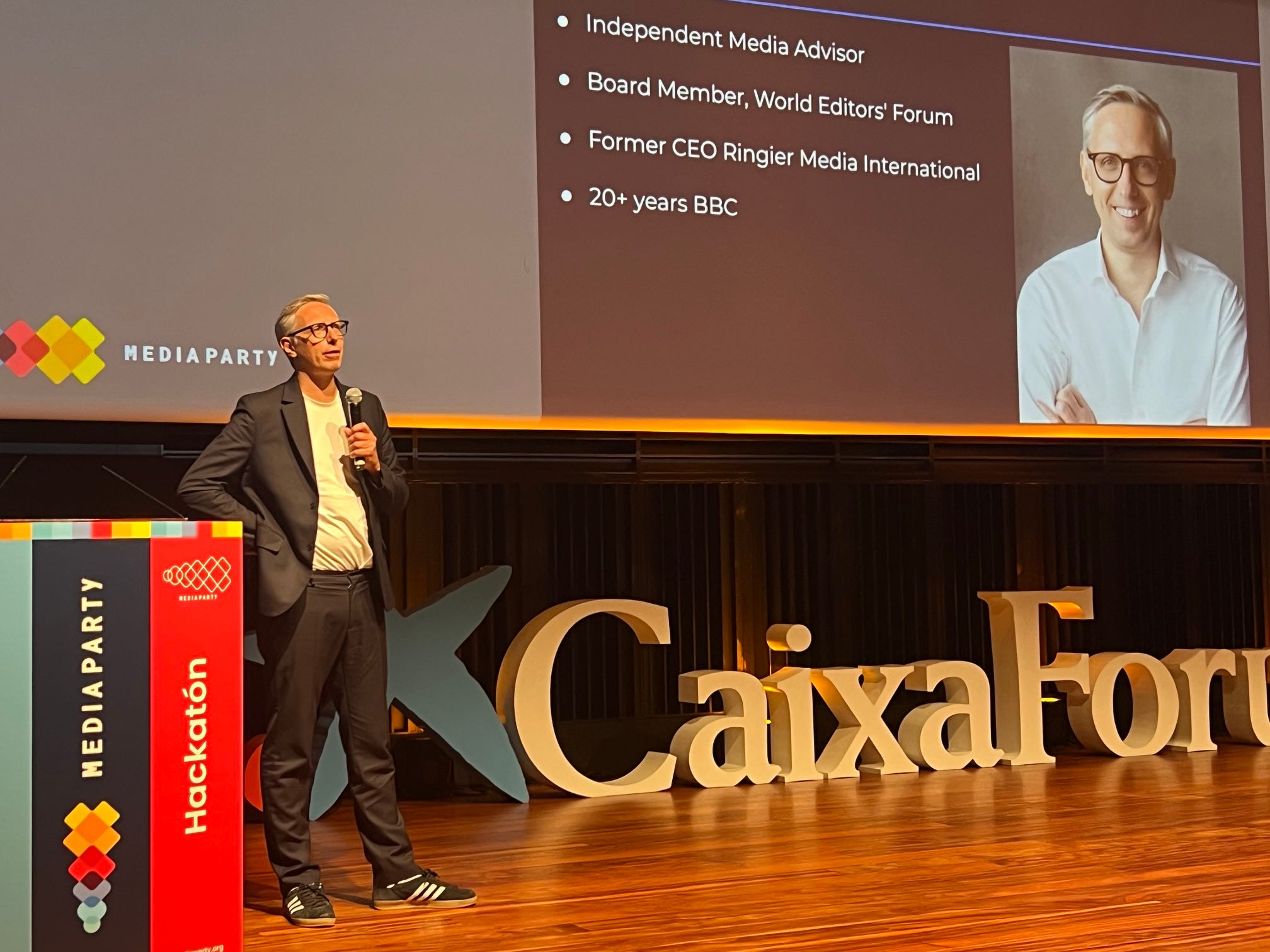
Every topic a publisher covers, he argued, splits three ways: commodity content everyone has, and which can be automated, expert content only that newsroom can produce, and services built around the topic so that readers can do something with it. “Content by itself is not going to be enough for people to keep coming back.” Most organisations cannot say how their own output divides. “If I were to ask a lot of media, they will not even be able to say what is the balance between our generalist content and expert content, for example. Nobody is tracking that.”

Liquid content needs solid building blocks
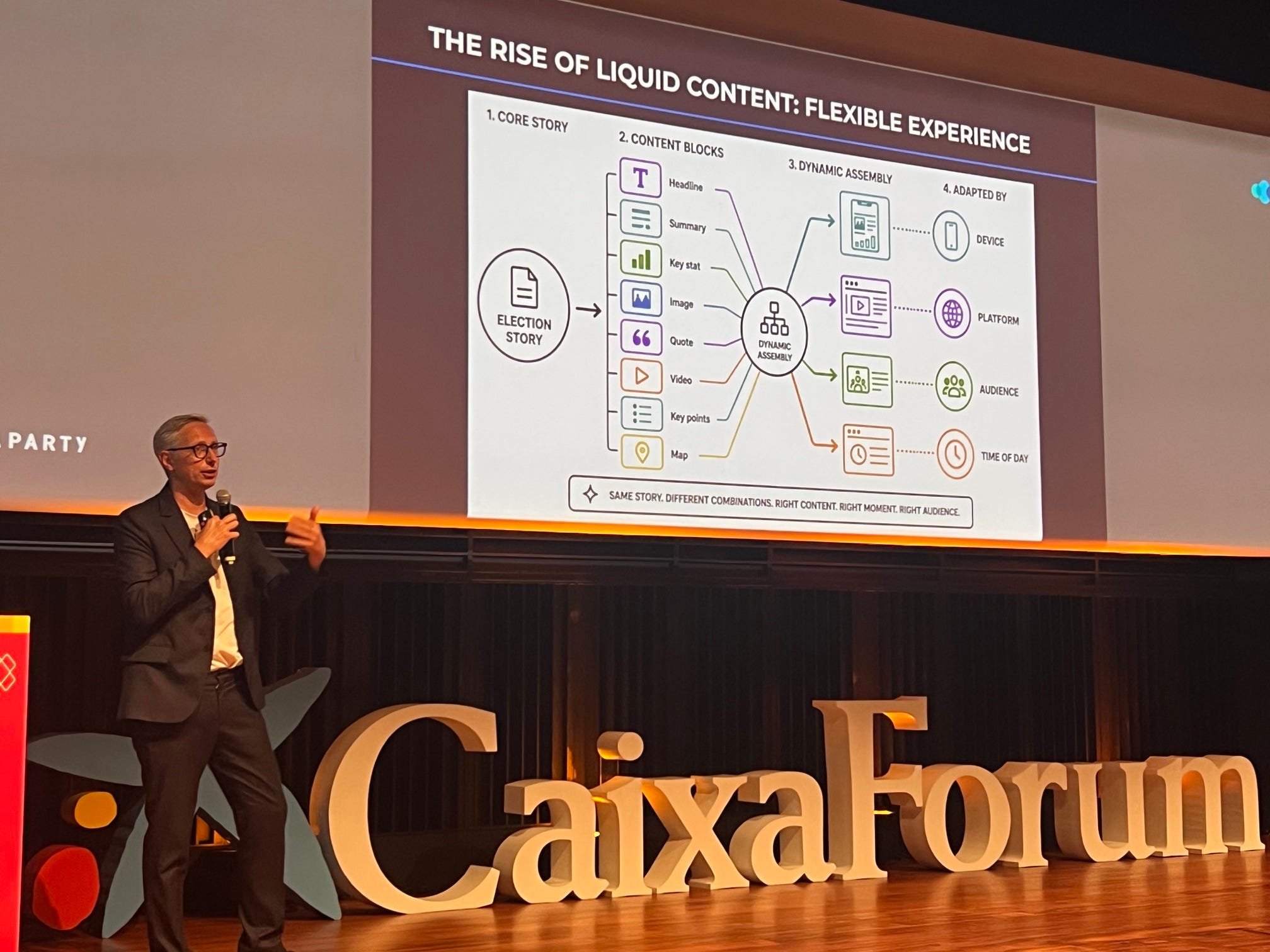
Newman’s examples of promising AI work all involved content coming apart and reassembling. Aftonbladet’s front-page chatbot prompts now draw 250,000 questions a week. The BBC, which has text for every Premier League club but could never staff a studio for each, is testing AI-generated daily audio briefings per club in the right regional accent. VG in Norway has built an experimental app for younger readers from its existing content, with no articles in it. “There are no editors, so all there is a system and monitoring after publication.”
The same survey found the industry unmoved by AI’s commercial effect. AI is embedded in research, headlines and workflow at almost every publisher, but heads of AI still decline to call it transformational. The vast majority said no jobs had been cut.
Shishkin’s diagnosis of that gap is structural. Newsrooms run newsletters, social, analytics, video and a CMS, and none of the data connects. “In order to be successful in the AI world, you need to create a shared taxonomy across everything that you do, you need to have one version of truth.”
In practice that means tagging every piece of content three ways. First, a detailed topic, not a single word like politics. Second, a format: interview, feature, write-up or Q&A. (Audio, video and text, in his scheme, are content types, not formats.) Third, the user need it serves. Work with smartocto has shown a personal finance story performing three times better as a listicle than as a write-up, a difference invisible unless format is tracked.
That tagging is what makes Newman’s liquid content intentional. Turning an updating story into an educating one is easy, because the archive supplies the material. Turning it into an inspiring one requires assets gathered on the ground, so the commissioning meeting has to know the permutations before the reporter leaves the building. “It’s not about creating better journalism anymore. It’s also about building systems that deliver the right journalism to the right person in the right form at the right moment.”
The agent will read paragraph five, if anyone tells it where to look
Newman’s next stage is agents working in the background on the reader’s behalf, and publishers expect them to do more damage than chatbots. Shishkin’s version is blunter. “You can be running a really important newsroom where important journalism is being done, and then everything will be completely flattened by AI agents that will come and pick something from you.”
His answer, in development since May, is an agent readiness layer: eight signals covering recency, provenance, attribution, sourcing, clarity and structured claims, so that content is retrievable, verifiable and comparable. His illustration was a ten-paragraph article visited by an agent comparing five sources. “Instead of them reading the whole article, they land on your page and you say, actually, your task means that paragraph number five is the most important paragraph for you to take.” At Monday’s workshop, participants scored a BBC News article and a Guardian article on the same story against the eight signals and agreed the Guardian did better. He offered the worksheet to anyone who asked. “Nobody else will solve it for us.”
Trust has moved to individuals, and Goalhanger has built a company on it
Newman’s second squeeze runs through people. Social media has stopped being social: a Financial Times chart shows only 17% of a Facebook feed coming from people the user knows. “These are content distribution networks designed to engage,” and the engagement is going to video networks and the creators on them. Respondents as a whole rate creators as more entertaining and easier to understand than journalists, and as less knowledgeable and less trustworthy. The quarter who actually use them rate creators better on every measure, trust included. “You see what you get. Whereas with news brands, there’s potentially hidden agendas.”
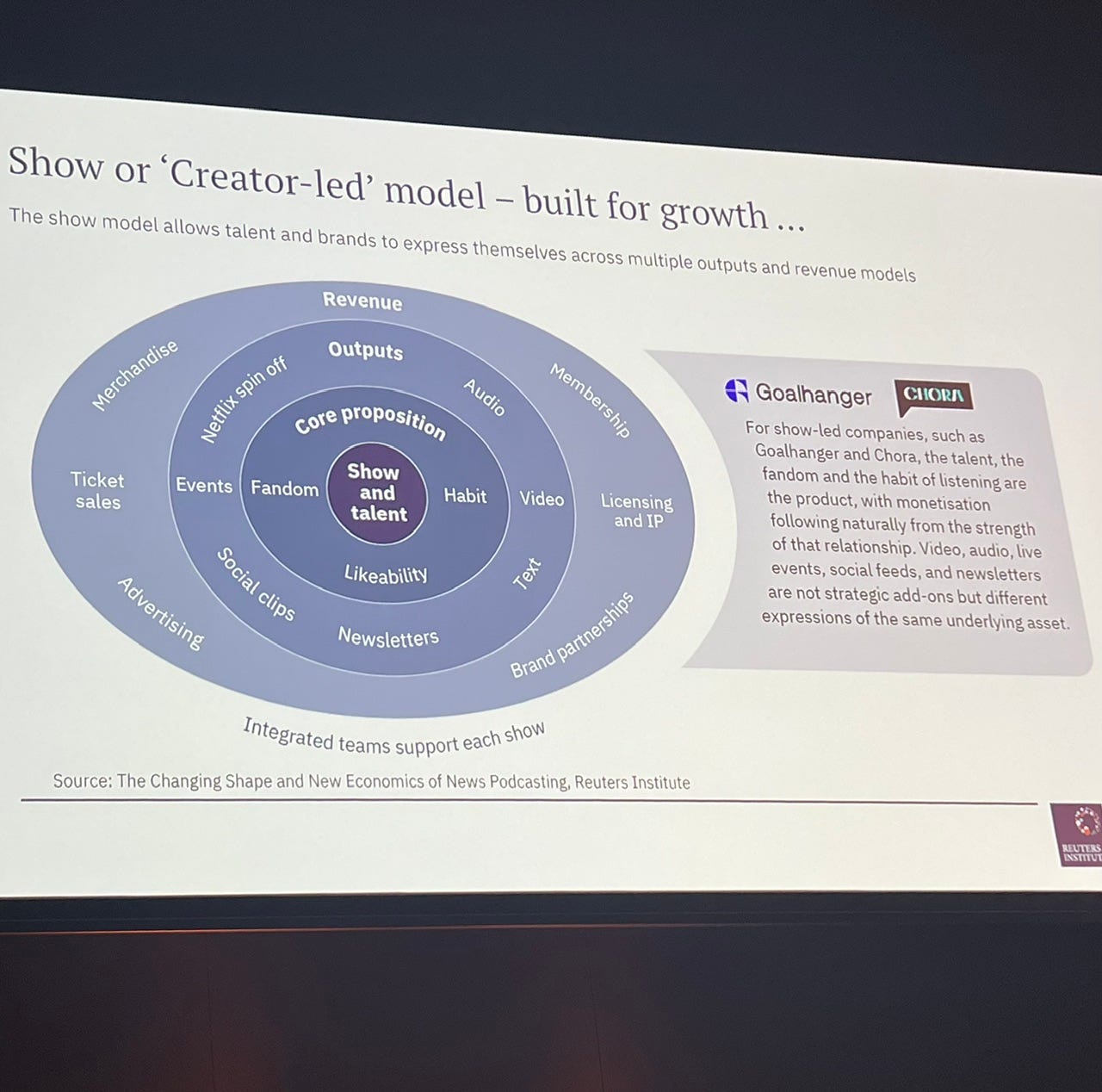
Publisher responses so far amount to making journalists more like creators, from Wired’s platform personalities to straight-to-camera video on the New York Times site. The model Newman singled out is Goalhanger, no longer in his description a podcast company. “It’s really about shows and talent.” Around the show sit audio, video, text, newsletters, social and increasingly television; around those sit membership, licensing, advertising, merchandise and ticket sales. Its South Bank event the weekend before the conference sold out.
In Shishkin’s terms that is a service built around content. It is also the one case where the taxonomy question barely arises: the relationship belongs to a person, and the format is the show.
Neither session argued that the strategy is wrong. Distinctive journalism from people audiences trust is a defensible answer to Newman’s charts, and Goalhanger shows what it looks like when it works. Shishkin’s warning was that most newsrooms cannot yet deliver it, because they cannot see their own output clearly enough to say what is distinctive, what is commodity and what an agent will find when it calls.