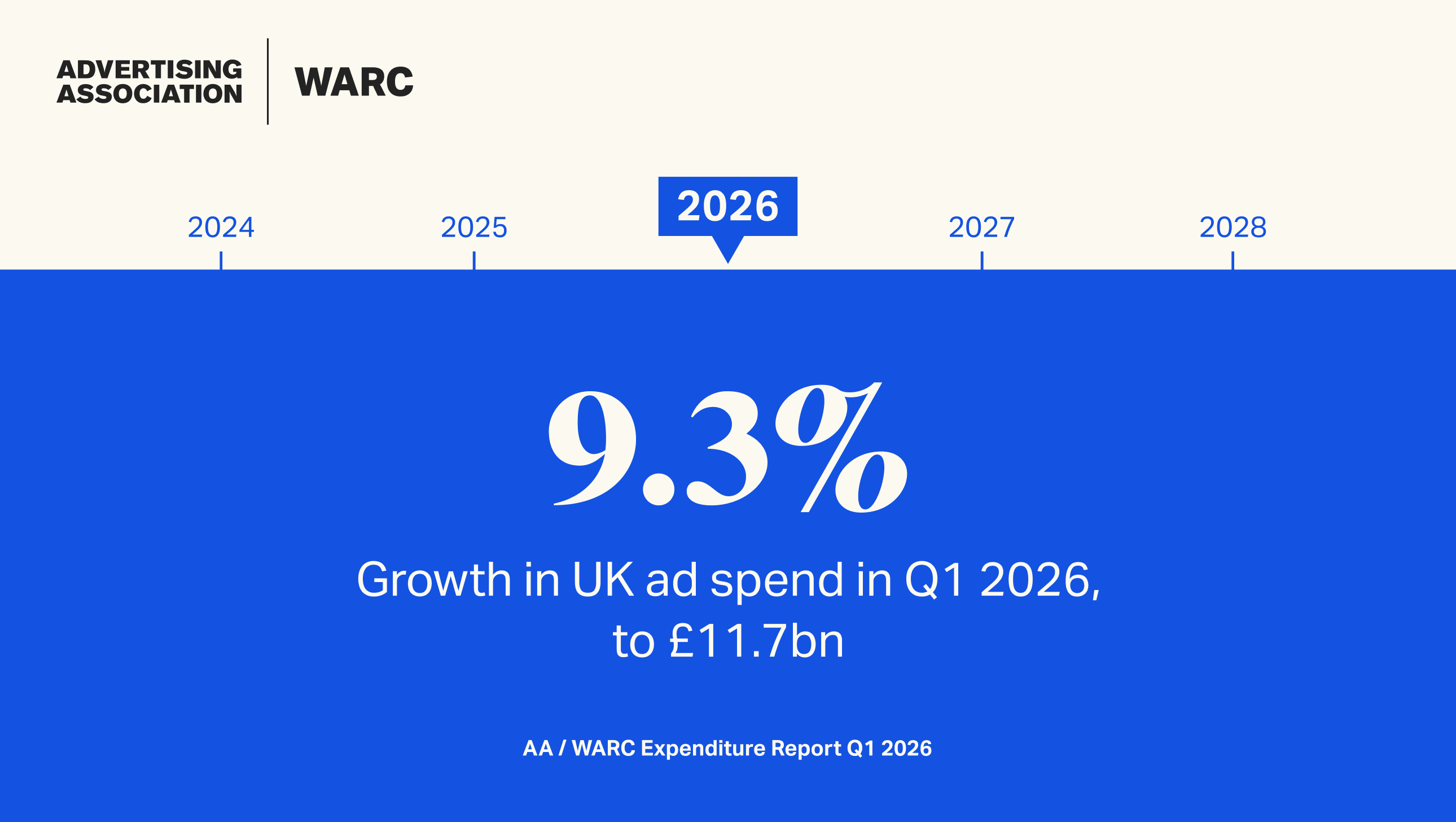
The UK economy grew 0.6% in the first quarter of 2026.UK advertising grew 9.3%. The latest Advertising Association/WARC Expenditure Report, published on 30 July, puts total investment at £11.7bn for the quarter, the strongest growth since Q4 2024 and 1.7 percentage points ahead of WARC’s own April forecast. After inflation, the rise is still 6.0%. The full-year forecast has been raised to £50.5bn, an 8.2% increase on 2025.
A market growing many times faster than its economy demands an explanation, so The Media Stack put the question to the people who compile the numbers: Stephen Woodford, Chief Executive of the Advertising Association, Suzy Young, Partner Relations at WARC Media, and Alex Brownsell, WARC’s Head of Content. The answer is a structural shift in who advertises at all.
The growth is coming from three million businesses that didn’t advertise before
Woodford’s starting point is that the disconnect is real but overstated. “The overall economy is sluggish, but advertising is clearly really dynamic in terms of its growth,” he said. “We are a very digitally advanced economy, in large part because we’re a very advanced e-commerce economy. The UK is number three in the world in terms of investment in AI and by far the European lead. I think there is a very British tendency to talk ourselves down.”
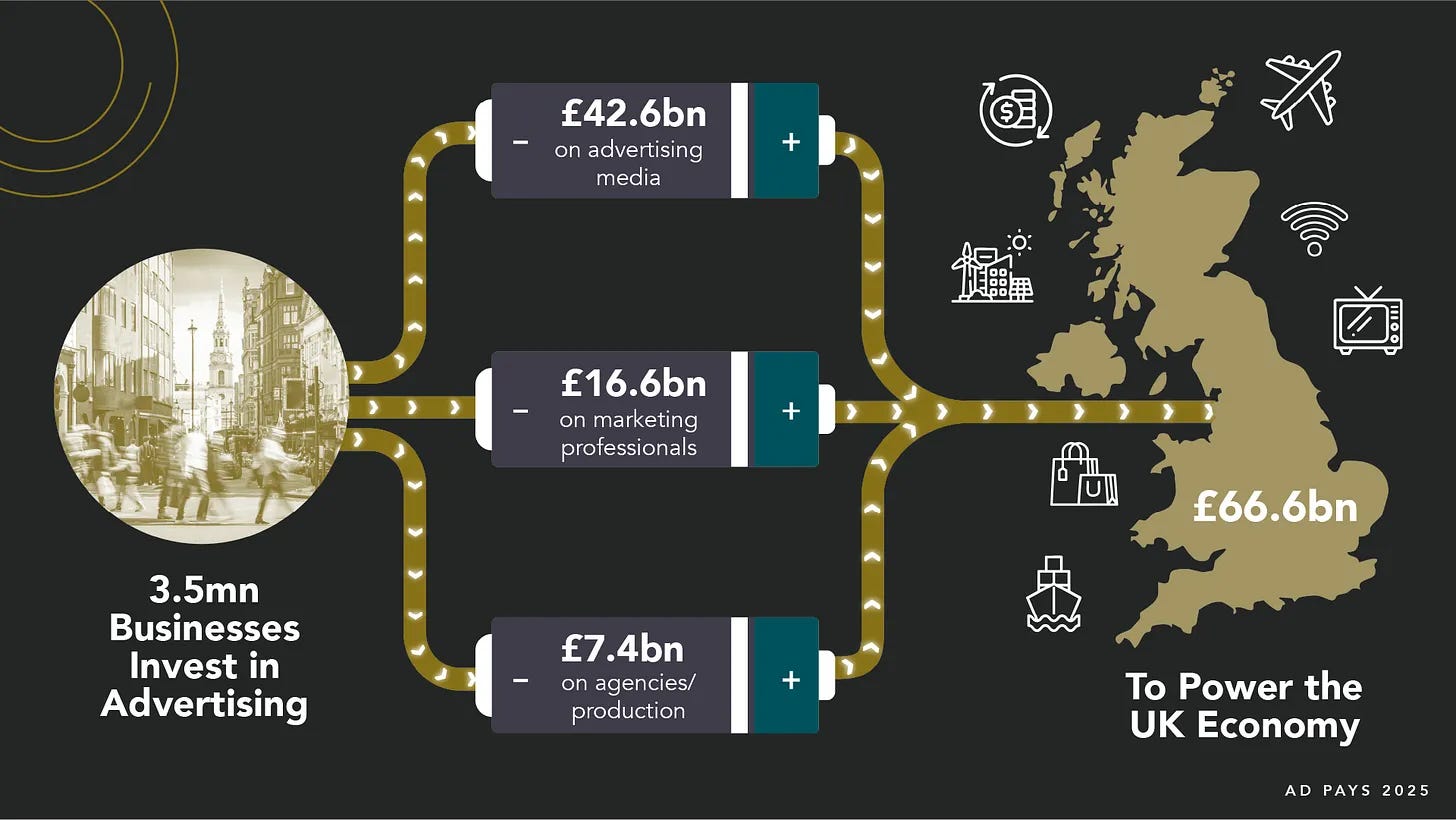
His fuller answer takes a 25-year view. In 2000, on his numbers, the UK had about three and a half million private sector businesses, and around 300,000 of them advertised. “Call it 8% of the businesses in the UK.” According to their Advertising Pays 2025 report, there are now around five and a half million businesses, and the number advertising has grown more than tenfold. “So around 60% of the businesses in the UK now use advertising.”
“Whether you’re a local builder or pet shop, or a giant multinational, and every type of business in between, you’re going to be using advertising to reach your customers,” Woodford said. “That advertiser growth has been another factor driving the growth in the ad market way ahead of the growth in the economy.”
That long tail advertises almost entirely on the platforms; some 90% of small businesses use digital advertising, by Woodford’s count. It explains the shape of the quarter: search up 9.8% to £4.6bn, social media up 17.7% to £3.1bn, retail media up 17.9% to £891m. The performance channels took roughly £8.5bn of the £11.7bn total.
Even the traditional channels are growing digitally
The report’s other pattern is that growth inside legacy media is digital growth. Digital radio was the fastest-growing line in the entire dataset at 22.1%; digital out of home rose 17.6%; addressable TV climbed 15.5% while total TV managed 0.8%. “Even in the traditional media sectors, it’s the digital formats that are growing fastest,” Woodford said. “The ability to use data and segment and become ever more efficient in your targeting is a key driver, which is absolutely not to say that broad reach media doesn’t still have a really important role.”
He is also wary of treating the headline number as a single market. “Historically, we’ve looked at broadly a £50 billion total ad investment as if it’s one homogenous market. Actually, it’s a hugely diverse market.” That concern will produce something new next April, when the full-year 2026 figures are published: “We’ll look at the spend pattern of the very large advertisers, classically the ISBA members, the advertisers that use IPA agencies, versus that long tail, but also try and segment the long tail between the micro businesses and the medium-sized businesses.”
A survey running since 1982, argued over every quarter
The Expenditure Report is cited from conference stages as the industry’s gold standard, but few of the people quoting it could say how it is made. Young, who compiles it, was pleased to be asked. “It stems from media owner surveys. It’s something the AA and WARC started all the way back in 1982, and the numbers have been compiled quarterly since then,” she said. WARC surveys the publishers directly, with digital revenues incorporated since 2011, and works with the trade bodies for the rest: Thinkbox, Radiocentre, Outsmart, IAB UK, Royal Mail and the Cinema Advertising Association. Forecasts fold in economic outlook, forward guidance, agency data and short-term factors such as elections and World Cups. This summer’s tournament is expected to help push Q2 growth to 8.9%.
Incoming data is sense-checked against the previous quarter before anything else. “Quite often we have methodological changes, so we have to be really careful that we’re ensuring the data are like for like,” Young said. Definitional disputes, such as whether YouTube watched on a television set counts as TV or digital, go to a quarterly forum where all the trade bodies argue it out. “It’s got to be agreed as fair by everybody.”
The categories themselves are still moving. Retail media and social media were broken out publicly for the first time in April. A pure-play online audio line, covering podcasts, is being worked on by the IAB and Radiocentre. And WARC is talking to the influencer marketing trade body about a line for the creator economy, with no illusions about the difficulty. “There’s no unified billing system. There’s no unified metrics,” Young said. Woodford is confident a number will come, “but it will be a process of gradual refinement, because it is such a complex market that doesn’t necessarily fit neatly into conventional definitions, with a blend of media, production and talent spend.”
Retail media has not peaked, but outside Amazon it is already slowing
Retail media grew 17.9% in the quarter and WARC forecasts 15.9% for the year. “I certainly don’t think it’s peaked. There’s a lot of headroom for growth,” Brownsell said, with the US market showing where the UK is heading. The qualification concerns who captures it. “Because of the dominance of players like Amazon, global retail media growth is now dropping down into single digits for the first time away from Amazon.” The task for Tesco, Sainsbury’s, Boots and the other local operators, all of which he sees doing “really exciting things”, is to capture share of budget against it.
Trusted news brands sat out a digital boom
The one corner of the market still shrinking through the boom is published media, down 5.9% in the quarter. National newsbrands fell 3.7%, and their digital revenues fell too: down 0.8% in a quarter when every platform channel grew by double digits. For the most trusted brands in British media, that is a bleak scoreboard.
Brownsell does not read it as a verdict on the journalism. “They have a challenge to tick certain boxes that the big tech platforms have been able to do, in terms of measurement, ability to target audiences, the optimisation side of things. But what they do have is that premium environment. They have the trusted audience engagement.”And the global picture is turning: “Having seen a precipitous decline over the last 10 to 15 years, we are now seeing stabilisation in ad spend with news brands and magazines, and actually we’re forecasting growth in global news brand ad spend next year.”
The longer-term threat is the one mapped in WARC and PHD’s From Abundance to Agents, which projects media and publishing as one of the categories most exposed to agent-mediated commerce. “Consumers in general seem to trust the algorithm to find the content they are likely to find most entertaining,”Brownsell said. His advice splits by scale. “Where there are strong publishing and media brands, it’s about doubling down on those direct relationships and, where possible, preventing disintermediation. For the longer tail, it is going to be a case of learning the new rules of distribution.”
Woodford sees a countervailing force. “One of the things the LLMs use to make recommendations is authoritative editorial content. What the Economist says will rank very highly. What third parties say about you becomes increasingly important.” In a world of machine-made abundance, he argues, “trusted brands, trusted voices just become even more important than they are now.” The economics, he concedes, lag the technology: “As technologies emerge, the economic models have got to catch up with them. There is a symbiotic relationship between them. If one in effect undermines or destroys the other, it ultimately undermines their own business.”
A Burnham bounce, in the report’s own words
The report itself wonders whether there will be “a noticeable ‘Burnham bounce’” in the second half. Woodford, asked about the new Prime Minister, reached first for stability: “Regardless of your politics, we need him and his administration to succeed. There are signs of a Burnham bounce in consumer confidence, which is a good thing to see.”
The optimism rests on Burnham’s record. A former Culture Secretary, he made the creative industries one of five priority sectors in the North West, where the MBacc (the Manchester Baccalaureate, Greater Manchester’s technical-education route) paired industry with education authorities and universities. “Manchester is the second city for advertising after London,” Woodford noted. James Purnell, another former Culture Secretary and a BBC alumnus, arrives as Chief of Staff, and Lisa Nandy stays at culture, which is the continuity Woodford wants. “We don’t want to see an ever-changing cast of ministers in key roles.”
The forecast has one standing risk attached: the intermittent Middle East ceasefire, and the chance that a protracted conflict feeds back into energy prices and inflation.
For now, the strongest quarter since the end of 2024 rests on millions of new advertisers buying performance media from a handful of platforms, while the country’s most trusted media brands wait for the machines that already read them to start paying them. The economic models, on Woodford’s telling, always catch up eventually.
Really interesting read. The shift toward digital performance media is clear, but the point about trusted content becoming more valuable in an agent-driven ecosystem is even more interesting.
As more advertising and discovery gets automated, the industry will need to look beyond reach and efficiency and ask a harder question: can the signals and sources driving these decisions actually be trusted?
In an increasingly algorithmic media ecosystem, trust may become one of the most valuable forms of media quality.








Really interesting read. The shift toward digital performance media is clear, but the point about trusted content becoming more valuable in an agent-driven ecosystem is even more interesting.
As more advertising and discovery gets automated, the industry will need to look beyond reach and efficiency and ask a harder question: can the signals and sources driving these decisions actually be trusted?
In an increasingly algorithmic media ecosystem, trust may become one of the most valuable forms of media quality.