



WAN-IFRA’s Newsroom Summit, held at VG in Oslo on 18 and 19 November, kept returning to one answer: journalists the reader can name. The revenue case is still thin.
VG hosted the summit, and its Editor-in-Chief and Chief Executive, Gard Steiro, set the terms. Anyone running a newsroom whose main purpose is generic news should “get a new job”, he said, because AI will turn routine reporting into a commodity. The two days that followed focused on what a publisher sells once that happens.


The middle of the market is going, and the first reader may soon be a machine
Steiro wants VG at the premium end of a market whose middle he expects AI to hollow out. By premium he means journalism that is unique and presented in a way people will pay for. VG now scores every article twice. A language model rates uniqueness by looking for signals such as VG’s own sources and a reporter at the scene, and a formula rates how it performed with readers. The chart that plots the two is the first thing Steiro looks at each morning and is meant to replace the most-read list in department meetings.

In one sample, three-quarters of what sports desks published was exposed. Dmitry Shishkin, presenting with the analytics company Smartocto, looked at more than 30,000 sports articles from 13 European brands: 75% were result updates, and the other 25% drew the most engagement. Commodity news, he said, will be “out-commoditised by somebody else very, very quickly”.
At this year’s World Cup, Norway reached a quarter-final for the first time and other broadcasters held the rights, yet VG remained Norway’s biggest online newspaper throughout, said Øyvind Brenne, its Development Editor.
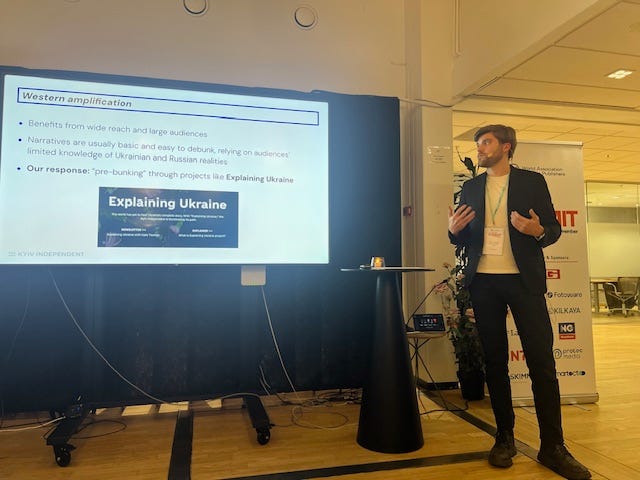
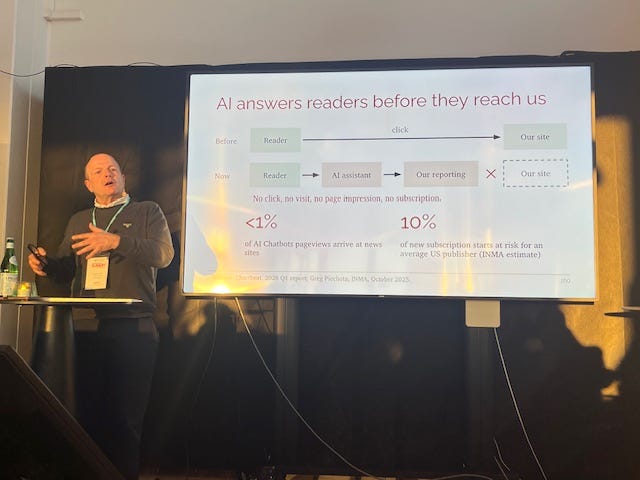
The buyer is changing as well as the product. Christian Tretbar, Editor-in-Chief of Tagesspiegel, expects the first reader of an article to be a machine before long, with people building what they read from what the machine extracts. Martin Fornusek of the Kyiv Independent described who already writes for that reader. One Russian network of close to 200 near-identical sites, which republish state media content, is not meant to be read by people. It exists to flood search results and, increasingly, to feed large language models. On 2 November a clash outside a National Guard building near Kyiv was spun into a story about torture chambers, and by the afternoon of 3 November the network had run about 1,500 versions of it.
What publishers have left to sell is a person who can be named
Dietmar Schantin, a newsroom strategist, drew the line between machine work and human work most plainly. AI can gather facts, sort them and supply context. Deciding what the story is and what to leave out belongs to a named person, because accountability is what publishers still have to sell. He would keep AI out of the reporter’s first draft, the job where it saves most time.
VG has found that presence must show in the copy. Its development team described sports reporters who flew to a Champions League match and scored poorly for uniqueness because the copy never said they were in the stadium. At The Times, Steven Swinford, the Political Editor, goes into the live blog’s comments as soon as Prime Minister’s Questions, the weekly session in the House of Commons, ends, having watched it from inside the chamber.
Being there is one half of it; being known is the other. Vink, Aftenposten’s food-and-drink brand for 25-to-35-year-olds in Oslo, made two social media journalists the faces of its channels in August 2024, and they are now recognised in the street. Its videos look much like those of food influencers, said Øystein Aldridge, who runs it, with one difference: Vink pays for every meal.

The named journalist brings readers into the work
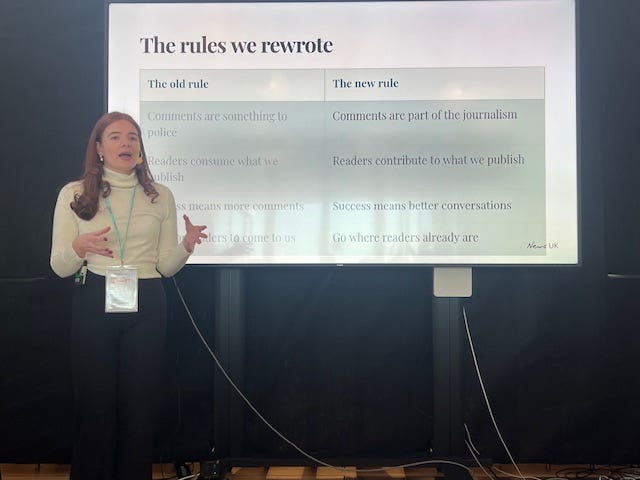
Rachel Duffy, Head of Community at The Times and Sunday Times, had a number for anyone who thinks comment sections are a cost centre. The titles receive about 650,000 comments a month, and readers who open the comments under an article spend 41% of their time on it reading them. Her team is four people. Community needs no new product, she concluded, because the readers are already in the thread, and she sends writers to join them. Times readers at the World Cup supplied pictures and video for the match live blogs.
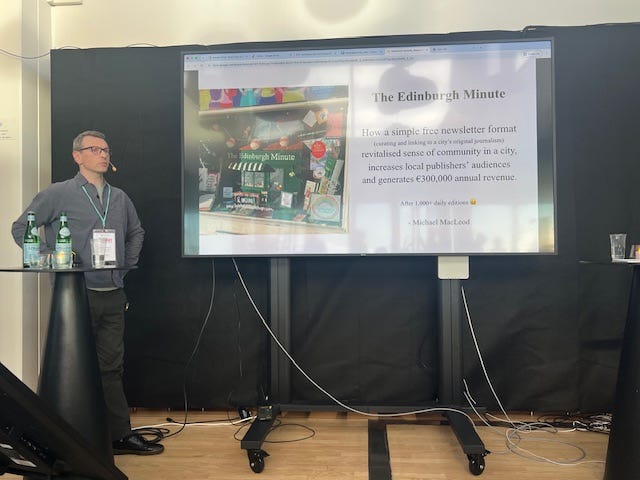
At the other end of the scale, Michael MacLeod’s Edinburgh Minute is a daily email to about 30,000 people that summarises the city’s news in his own words, names the reporter and links to the original, sending 5,000 to 10,000 clicks an edition to local publishers. Two-thirds of the content comes from readers, charities and event organisers, who submit 40 to 50 items a day for him to verify. He works alone, takes no advertising and turned down £50,000 from a property company to keep it that way. He will not build a newsroom. “I don’t want to add to that noise,” he said.
The teams doing the work are small and build their own tools
Small teams are doing much of this work, and some publishers are reorganising around them. Tretbar has abolished Tagesspiegel’s separate sales and product units and seated their staff in the newsroom. They work in three “missions” that follow the life of a subscriber, under a product lead who reports to the Editor-in-Chief rather than the publisher. The wall between advertising and editorial stays. For subscriptions, he has removed it, and he described the change as power returning to editors who had spent a decade filing requests with the tech team to alter their own homepage.
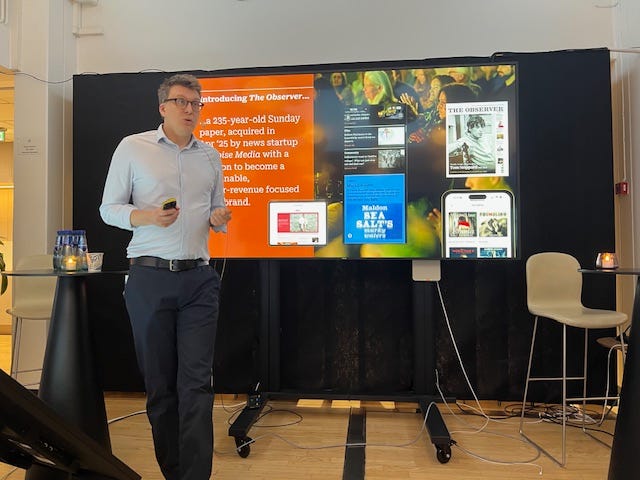
The Observer launched digital subscriptions on 27 November 2025 and has more than 70,000 subscribers, which includes print subscriptions, said Jack Riley, its Chief Customer Officer. The development team is seven strong. Riley counts as the eighth an AI agent, built on Claude and connected to the team’s design, code and data tools, which lets people who are not engineers, himself included, release features on the live site. Whatever is built in an afternoon, he conceded, must be maintained by the same seven people.
The link to revenue is unproven, and the faces can leave
Little of this has been shown to pay, and the speakers said so. Aldridge called Vink an experiment and said the link between social attention, readership and subscriptions is still unclear. “Nobody subscribes on a first date,” said Liesbeth Nizet, Chief Future Audiences & Growth at Mediahuis, who accepts that not everyone will pay. Steiro said progress on VG’s score is “moving slowly”.
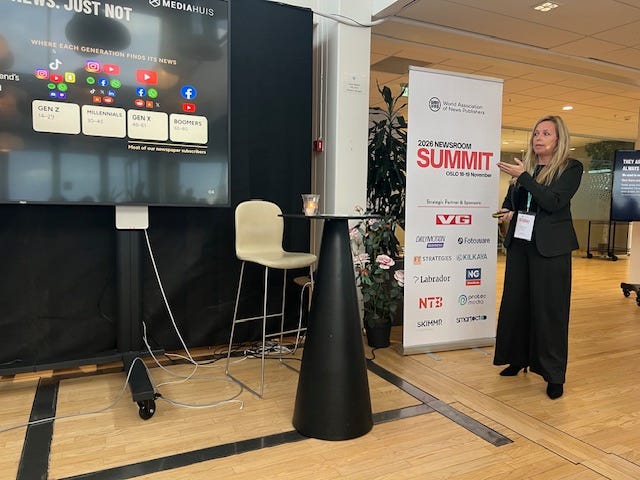
If the value lies in named individuals with followings of their own, the publisher owns less of the relationship than it did when readers came for the masthead, and the individual can take it elsewhere. The Observer already gives its best-known writers Substack-style tools to run their own newsletters. Nizet said journalists publishing under their own names from inside a newsroom raise questions Mediahuis has not yet answered. Nor did the summit. The masthead used to be the thing readers trusted; the speakers in Oslo were describing a world in which it borrows that trust from its own staff. Steiro told the generic newsroom to find a new job. The non-generic one has found a new job too, and has not yet worked out what it pays.