



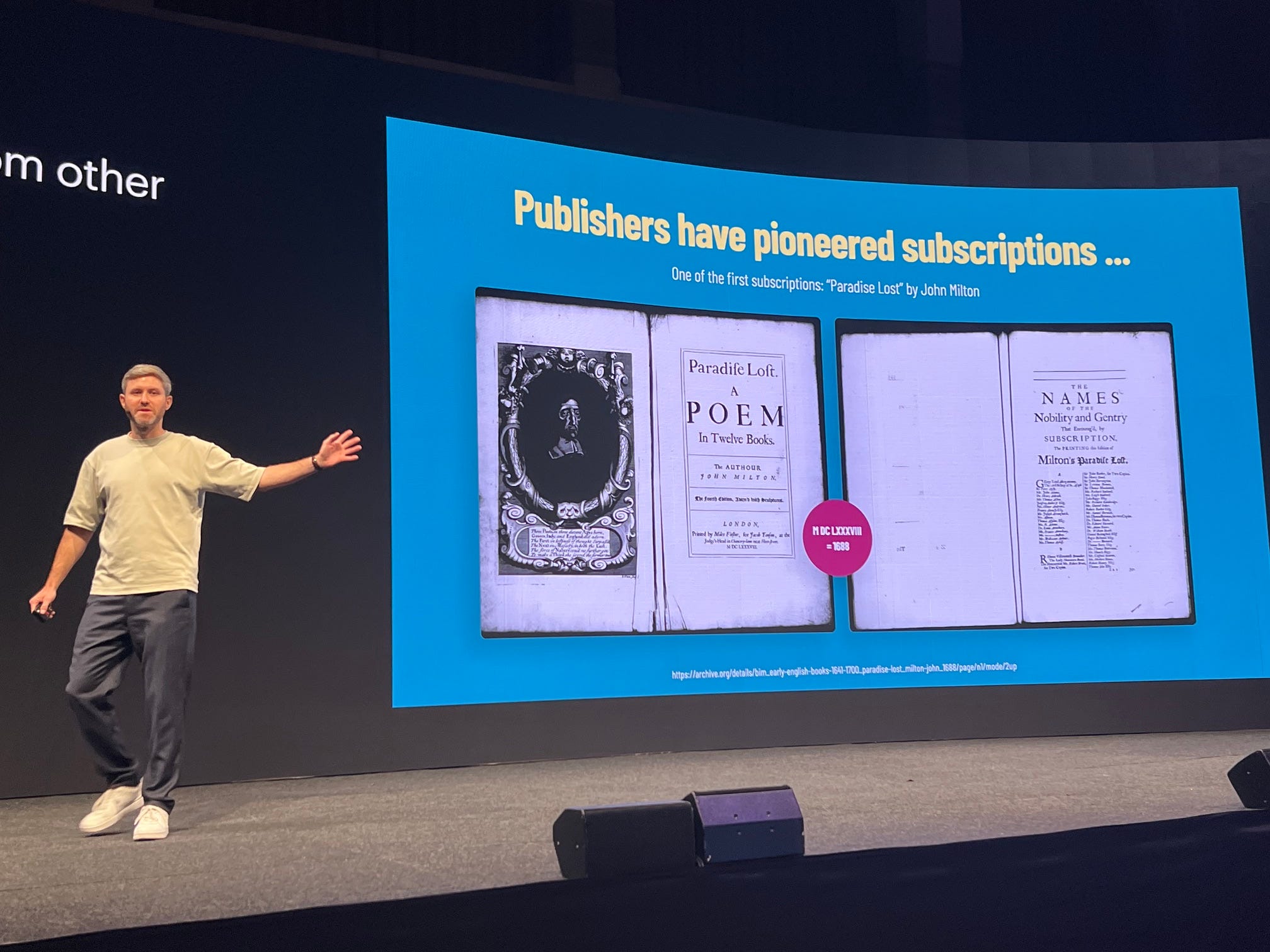
None of the three case studies Lennart Schneider brought to Piano Academy in Amsterdam publishes news. His examples came from a restaurant app, a language app and a book-summary service, and he argued that publishers, among the oldest sellers of subscriptions, now have most to learn from businesses that came to the model late.
Schneider spent more than six years at Die Zeit, where he helped build the Freunde der ZEIT loyalty programme, before setting up as an independent subscription consultant. He hosts Subscribe Now, a German-language podcast that interviews subscription operators across sectors, and Haufe published his book of the same name in June.
The reader who already pays is the cheapest acquisition channel
NeoTaste launched in Germany in 2021 and sells a subscription to restaurant deals, typically two main courses for the price of one. It now operates in more than 50 cities and says it has more than 2 million users. Much of that growth comes from existing users. “Their users are their best marketers,” Schneider said.
The programme is built to take as little effort as possible. A subscriber generates a personal referral link with one tap and sends it to a friend, who lands on a personalised page and joins for free for a month. The referrer also gets a free month, and an account page shows which invitations have been accepted. The new member can then start the loop again.
Schneider took the finer points from a podcast interview with Stefan Bader, Chief Executive and Co-founder of Cello, a Munich company whose referral software runs programmes for NeoTaste, Miro and Riverside. The most common error, Bader told him, is burying the programme in a menu nobody opens. It belongs on the first screen of the app. The best moment to ask is straight after a good experience, which Bader calls a moment of delight. For NeoTaste, that is the meal itself. For a publisher, Schneider suggested, it could be the end of an article or a finished game.
Rewards range from free months to cash and, for AI tools, usage credits. Each business has to test what works for it. The rule Schneider passed on from Bader was that “the rewards have to feel fair and balanced on both sides.”
Duolingo grew by counting who came back the next day
Referral brings people in; Duolingo’s case was about keeping them. By 2018, its daily active users had stalled. The company looked to mobile gaming for ideas and settled on a single product metric: current user retention rate, or CURR. A current user is active today and was also active at least once in the previous seven days. CURR is the share of those users who return the next day. Over the next four years, daily active users grew 4.5 times. Duolingo’s shareholder letter for the second quarter of this year put CURR at an all-time high of 84%, up about a point on a year earlier.
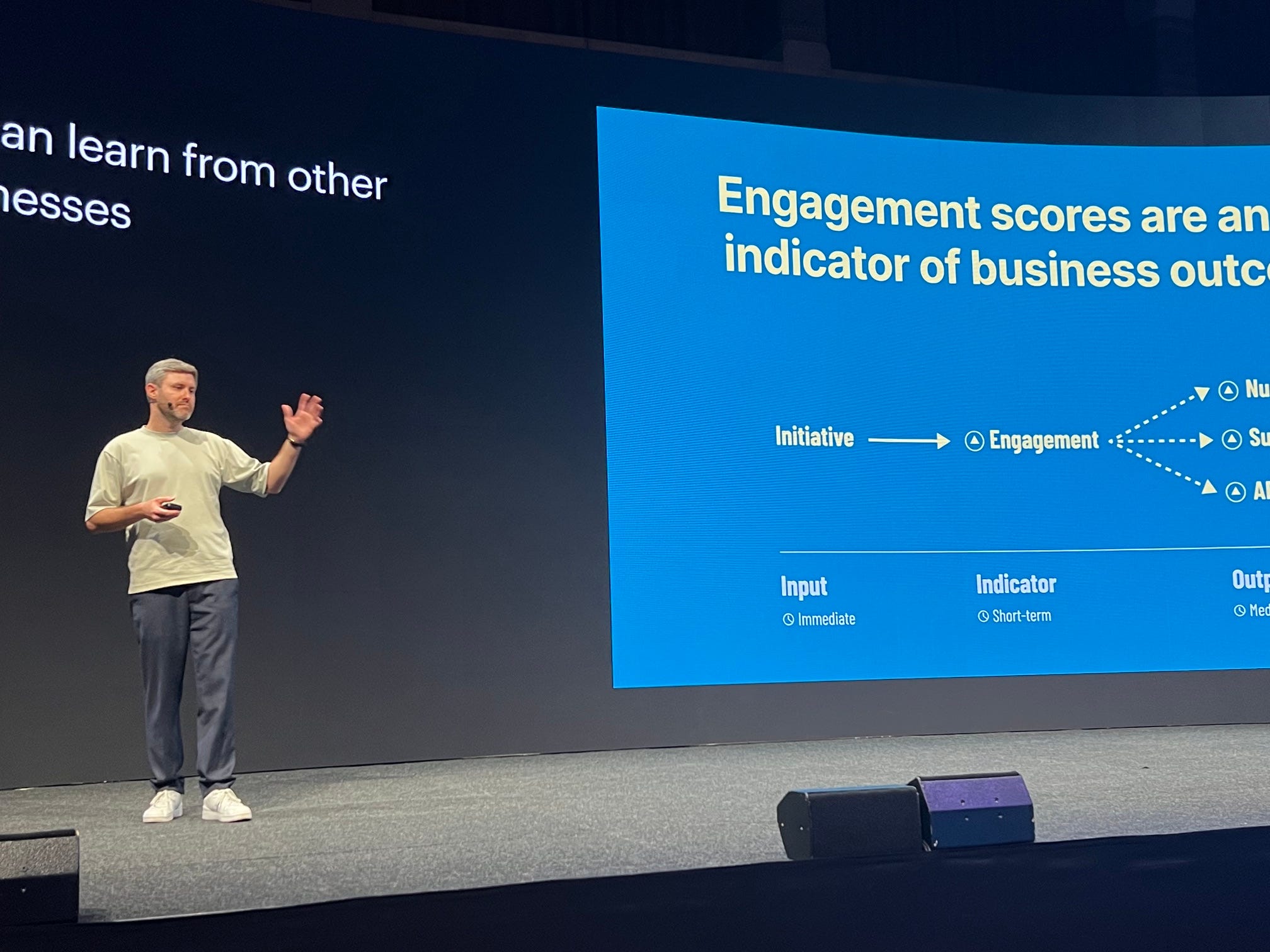
Schneider’s argument for paying attention rests on the lag built into subscription businesses. A product change or CRM campaign may move churn months later, by which point the cause is hard to isolate. Engagement scores shorten the wait, which is why publishers already use them: the Financial Times’ recency, frequency and volume model, median time spent, or the ratio of daily to monthly active users. Duolingo’s version demands a daily return.
Every user is assigned each day to one of seven mutually exclusive states. Active users are new, current, reactivated after more than a week away, or resurrected after more than 30 days. Each movement between states has a conversion rate, and each conversion rate can be the target of an experiment. With search traffic falling, Schneider argued, publishers face the same arithmetic. “We have to do more with less, and that means that we have to re-engage our existing user base,” he said.
Duolingo runs hundreds of experiments a year to that end. One prompts users to install a home-screen widget that changes with their state and the time of day, and grows more distressed the later it gets without a lesson completed. Schneider also showed slides from the Duolingo Handbook, the company’s published account of how it works. By his account, only about half of Duolingo’s experiments ship, because it tests outlandish ideas alongside obvious ones; “sometimes better ideas come from the worst ideas,” as he put it. The company works to cut the time from idea to test to release, and insists the product stay fun, since learning a language is hard work and enjoyment is what brings people back. “We need to start focusing on habits, and habits mean daily routines that bring people back to our apps and our websites,” Schneider said.
Telling trial users when they would be charged sold more trials
The third example, from Blinkist, the Berlin book-summary app, concerned the free trial. Users start one, forget to cancel, get charged, then leave angry app-store reviews and ask for refunds. Blinkist’s data showed that a third of trial cancellations happened on the first day, before users had given the app a chance.
Its redesigned trial screen set out a timeline: full access today, a reminder two days before the seven-day trial ended, and the date the charge would land. To receive the reminder, users had to switch on push notifications. Trial sign-ups rose 23%. Cancellations fell because users waited to see what the app could do. Complaints dropped by about 55%. Push opt-ins rose from 6% to 74%, giving Blinkist a direct line to three in four trial users. The format, Schneider said, has since been copied across subscription apps.
His advice was to look beyond other publishers when redesigning a paywall. Mobbin, a library of screens and user flows from apps and software products, makes it easy to see what the leading subscription businesses do. “We have to be transparent. We have to show them how it works,” he said.

Publishers will need another industry’s vocabulary
Schneider ended by telling the room to skip the next publishing conference in favour of a SaaS or app event, and to follow the people who run those businesses through their podcasts, newsletters and LinkedIn posts. The point was partly linguistic: “they are sometimes using very different words when they are talking about the same things.”
The designer behind Blinkist’s redesign later wrote that the company had been making money from users who forgot to cancel. Publishers with auto-renewing trials and cancellation pages that take some digging collect a share of that money. Blinkist gave its share up and sold more trials. Few finance directors will sign off on that trade based on another company’s A/B test.