




This is a guest post by Steven Wilson Beales, an SEO and Content strategy consultant.
Earlier this month I ran a piece of research to see just how valuable an ‘About’ page was for news publishers when it came to AI visibility - you know, that page hidden down in the website footer that only the most curious ever read.
To investigate this, I tested 201 questions across ChatGPT, Copilot, Gemini and Google AI Mode. The final dataset contained 4,003 answers and 20,016 citations, collected between 2 and 6 September 2026. The questions covered four broad themes: trust, subscription value, specialist authority and publisher identity.
The clearest finding was that the About page is only one part of the picture. In 76% of publisher cases, no About page appeared in the cited evidence at all. Trust questions drew heavily on journalism, standards and accountability material. Value-for-money questions brought subscription and pricing pages into play. Specialist authority was demonstrated largely through journalism itself, while identity questions were much more likely to surface the About page.
This is why I think AI visibility for publishers is better understood as an evidence architecture problem than an About-page problem.

In about half of the cases, AI cited only one page from a publisher. But when two or more pages were cited, they were different types of content in roughly two-thirds of cases. A news article might appear alongside a subscription page, standards document or corporate page.
The question publishers should therefore be asking is not simply “Which page should we optimise?” but “What evidence would an AI need to support the things we want audiences to believe about us, and where does that evidence live?”
Trust needs evidence, not just claims
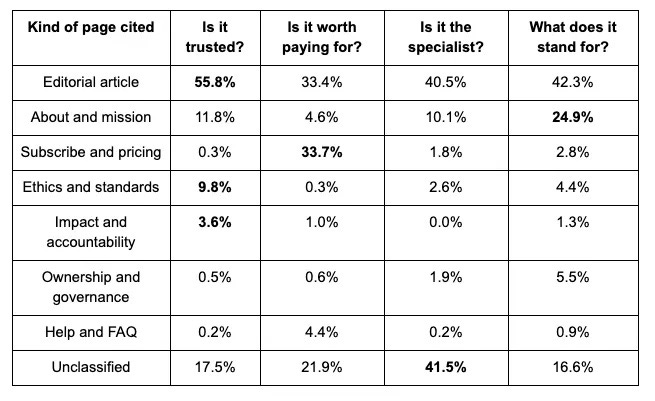
Trust produced one of the clearest patterns. Editorial articles represented 55.8% of trust citations, while ethics and standards pages accounted for 9.8%. About pages accounted for 11.8%.
Reuters is a good example. When asked which US news brands had the strongest reputation for accuracy and reliability, the evidence included a standards page, an article explaining visual verification and a piece involving editor-in-chief Alessandra Galloni. Its general About page did not appear.
Saying “we are trustworthy” is a claim. Showing how information is verified, how errors are corrected, how complaints are handled and how editorial independence is protected is evidence.
Publishers should therefore think of corrections pages, standards documents, fact-checking policies and explanations of reporting methods as trust assets rather than administrative housekeeping. A static sentence saying that you correct mistakes is very different from maintaining a visible record showing that you actually do it.

Subscription pages are part of the brand story
The evidence changed significantly when models were asked whether a publisher was worth paying for. Subscription and pricing pages accounted for 33.7% of value citations, making them the largest individual page category.
The Guardian illustrates how broad this evidence can become. When asked why someone should pay the publisher every month, ChatGPT cited material covering governance, pricing, mission, financial results, the Scott Trust, and reader revenues. Mediapart produced a similar mixture, including an activity report, its subscription portal, a help-centre pricing article, its About page and editorials about independence.
A subscription page is therefore doing more than trying to convert somebody who has already decided to buy. It may also become one of the main pieces of evidence an AI system uses when deciding whether a publisher represents good value.
That means these pages should explain more than the price. They should clarify what the reader gets, what is distinctive, what different tiers include, what reader funding enables, and why the product is worth paying for.
Help centres deserve attention too. Some of the information shaping how AI describes a publishing product may live inside customer-support software that editorial and SEO teams rarely examine. These pages need to be crawlable, current and consistent with the proposition being communicated elsewhere.
Specialist authority still comes from the actual journalism
There appears to be no shortcut to subject authority. Editorial articles accounted for 40.5% of citations in specialist questions. A further 41.5% was unclassified, but when I checked a sample of those pages, 79% of the ones I could confidently classify were ordinary editorial articles. The real role of journalism is therefore probably higher than the headline figure suggests.
If a publisher wants to be considered authoritative in personal finance, football, travel, politics or product reviews, it ultimately needs to publish strong journalism in those areas.
Methodology can strengthen that evidence. IndyBest, for example, has pages explaining how it tests products and who its experts are. In subjects such as health, science, finance, reviews or investigations, explaining how journalism is produced can provide useful supporting evidence for why it deserves to be trusted.
But there is no evidence here that publishers can simply add a handful of authority pages to thousands of pieces of commodity content and expect AI systems to treat them as specialists. The journalism itself still has to do the work.
The About page still matters, just not for everything
None of this means About pages is unimportant. About and mission pages represented 24.9% of identity citations, and nearly a quarter of identity answers relied on an About page alone.
They remain particularly useful when AI is trying to establish who a publisher is, what it stands for and what makes it different. The mistake is expecting the same page to demonstrate subscription value, journalistic trustworthiness and specialist authority at the same time.
Shorter questions make this even more interesting. Compared with longer questions, models cited less journalism (32% vs 42%) and more pricing pages and homepages. They also stopped after one page nearly six times in ten. Surprisingly, About pages were cited less frequently on these shorter queries.
Axios provides a useful example. For the four-word query “what is axios known for”, ChatGPT cited seven pages across four different types. The largest source of evidence was not the newsroom but the help centre, including pages explaining what Axios is, what it covers and how its product works. Across repeated runs, help-centre pages appeared more often than the About page.

Think about the evidence behind the claims
The practical lesson is to identify the claims you want AI systems and audiences to make about your brand, then make sure the supporting evidence exists.
If you want to be considered trustworthy, can somebody easily find your editorial standards, corrections, complaints process, fact-checking approach and evidence of independence? If you want to be considered worth paying for, is it obvious what subscribers receive, why the product costs what it does, what reader revenue enables and what makes the proposition distinctive? If you want to be seen as a specialist, is there sustained high-quality journalism, visible expertise and clear methodology where it matters? And if you want to be described accurately, can an AI system easily establish who you are, who owns you, how you are funded and what makes you different?
Then there is another question that may be even more important: are all of those pages telling the same story?
If an About page says independence is fundamental, the subscription page says reader revenues protect that independence, the standards page explains how editorial independence is maintained and the journalism demonstrates it in practice, the publisher has not simply repeated one claim four times. It has created four different forms of evidence supporting the same proposition.
This also means AI visibility is not purely a newsroom SEO job. Important evidence may sit on subscriptions, support, marketing or corporate subdomains owned by entirely different teams.
In summary then, AI does not appear to form one fixed view of a publisher from one definitive page. When the question is trust, it looks towards journalism, standards and accountability. When the question is value, subscription and pricing evidence matters more. When the question is specialist authority, journalism itself is central. And when the question is identity, the About page finally earns its money.
AI visibility for publishers therefore looks less like optimising a couple of corporate pages and more like building a coherent evidence architecture across journalism, commercial pages, corporate information and accountability material.
There is no quick fix. The stronger strategy is to make sure the evidence supporting what you want audiences to believe about your brand exists, is discoverable, and tells a consistent story.
And that’s even before we touch on third-party citations, which is a whole different story.
To read the full report, visit:

If you like to reach out and discuss further, please contact Steve via:
https://www.stevenwilsonbeales.com/